Boundary Handling
Edge strategies that reduce bias near the ends of the data range.
Overview
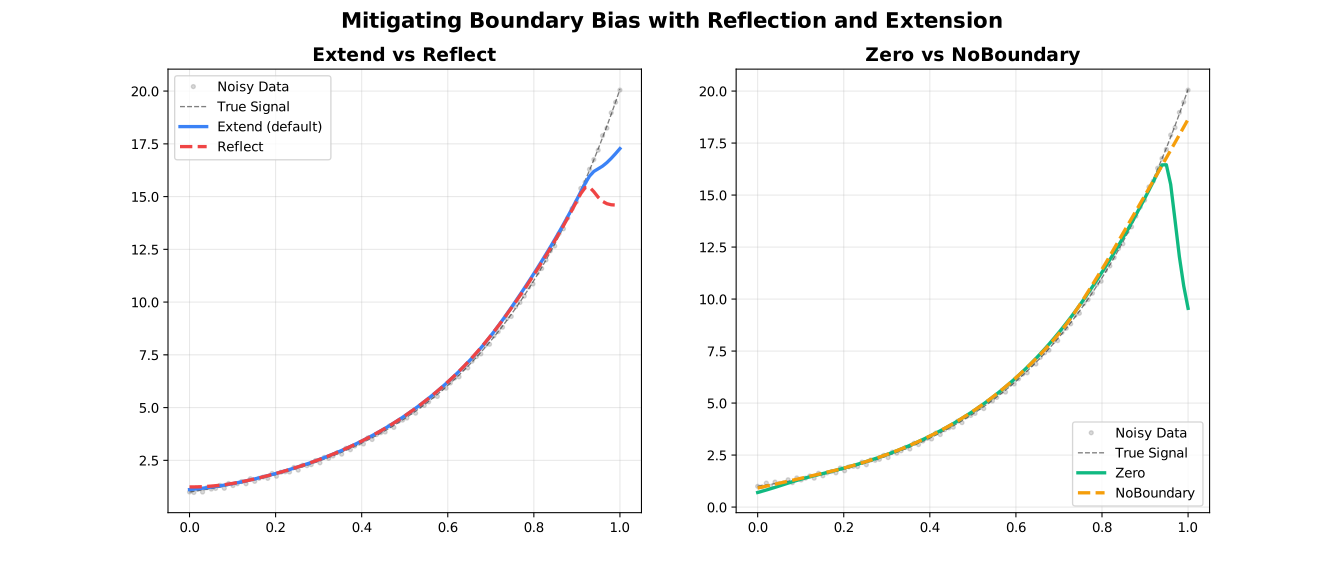
Section titled “Overview”Standard LOWESS neighbourhoods become asymmetric at the boundaries: fewer points exist on one side, pulling the local fit toward the data interior. The boundary_policy parameter controls how the data is padded to mitigate this effect.
| Policy | Padding Strategy | Best For |
|---|---|---|
"extend" | Repeat first / last value | Most datasets (default) |
"reflect" | Mirror data at boundaries | Periodic or symmetric data |
"zero" | Pad with zeros | Data known to approach zero |
"noboundary" | No padding (Cleveland original) | Reproducing reference behaviour |
Extend (Default)
Section titled “Extend (Default)”Pads beyond both endpoints by replicating the first and last observed values. Prevents the fit from curling toward zero and is a safe default for nearly all use cases.
Use when: No strong prior on boundary behaviour; general-purpose smoothing.
const { Lowess } = require('fastlowess-wasm');
const n = 100;const x = Float64Array.from({ length: n }, (_, i) => i * 2 * Math.PI / (n - 1));const y = Float64Array.from(x, (xi, i) => Math.sin(xi) + (((i * 7 + 3) % 17) / 17 - 0.5) * 0.6);
const model = new Lowess({ boundary_policy: "extend" });const result = model.fit(x, y);console.log("y[0]:", result.y[0].toFixed(4));
y[0]: 0.1662Reflect
Section titled “Reflect”Mirrors the data about both endpoints before fitting, then discards the reflected region from the output. Preserves continuity of derivatives, making it ideal for periodic or spatially symmetric signals.
Use when: Circular data (e.g., angle, day-of-year), symmetric physical quantities, or when the derivative at the boundary should be near zero.
const { Lowess } = require('fastlowess-wasm');
const n = 100;const x = Float64Array.from({ length: n }, (_, i) => i * 2 * Math.PI / (n - 1));const y = Float64Array.from(x, (xi, i) => Math.sin(xi) + (((i * 7 + 3) % 17) / 17 - 0.5) * 0.6);
const model = new Lowess({ boundary_policy: "reflect" });const result = model.fit(x, y);console.log("y[0]:", result.y[0].toFixed(4));
y[0]: 0.5823Pads with zeros beyond both endpoints. Appropriate when the underlying process is known to be zero outside the observation window (e.g., a pulse signal or a bounded physical quantity).
Use when: Signal decays to zero at both ends; zero is a meaningful boundary value.
const { Lowess } = require('fastlowess-wasm');
const n = 100;const x = Float64Array.from({ length: n }, (_, i) => i * 2 * Math.PI / (n - 1));const y = Float64Array.from(x, (xi, i) => Math.sin(xi) + (((i * 7 + 3) % 17) / 17 - 0.5) * 0.6);
const model = new Lowess({ boundary_policy: "zero" });const result = model.fit(x, y);console.log("y[0]:", result.y[0].toFixed(4));
y[0]: 0.2625No Boundary
Section titled “No Boundary”Applies no padding. Each local fit uses only the points that are actually available, which may be fewer than the requested neighbourhood at the endpoints. This reproduces the original Cleveland (1979) algorithm exactly.
Use when: Reproducing reference results; you prefer the raw LOWESS boundary behaviour.
const { Lowess } = require('fastlowess-wasm');
const n = 100;const x = Float64Array.from({ length: n }, (_, i) => i * 2 * Math.PI / (n - 1));const y = Float64Array.from(x, (xi, i) => Math.sin(xi) + (((i * 7 + 3) % 17) / 17 - 0.5) * 0.6);
const model = new Lowess({ boundary_policy: "noboundary" });const result = model.fit(x, y);console.log("y[0]:", result.y[0].toFixed(4));
y[0]: 0.5702Choosing a Policy
Section titled “Choosing a Policy”| Situation | Recommended Policy |
|---|---|
| General purpose | "extend" (default) |
| Periodic signal (angle, day-of-year) | "reflect" |
| Signal known to be zero at boundaries | "zero" |
| Replicating original Cleveland behaviour | "noboundary" |