Cross-Validation
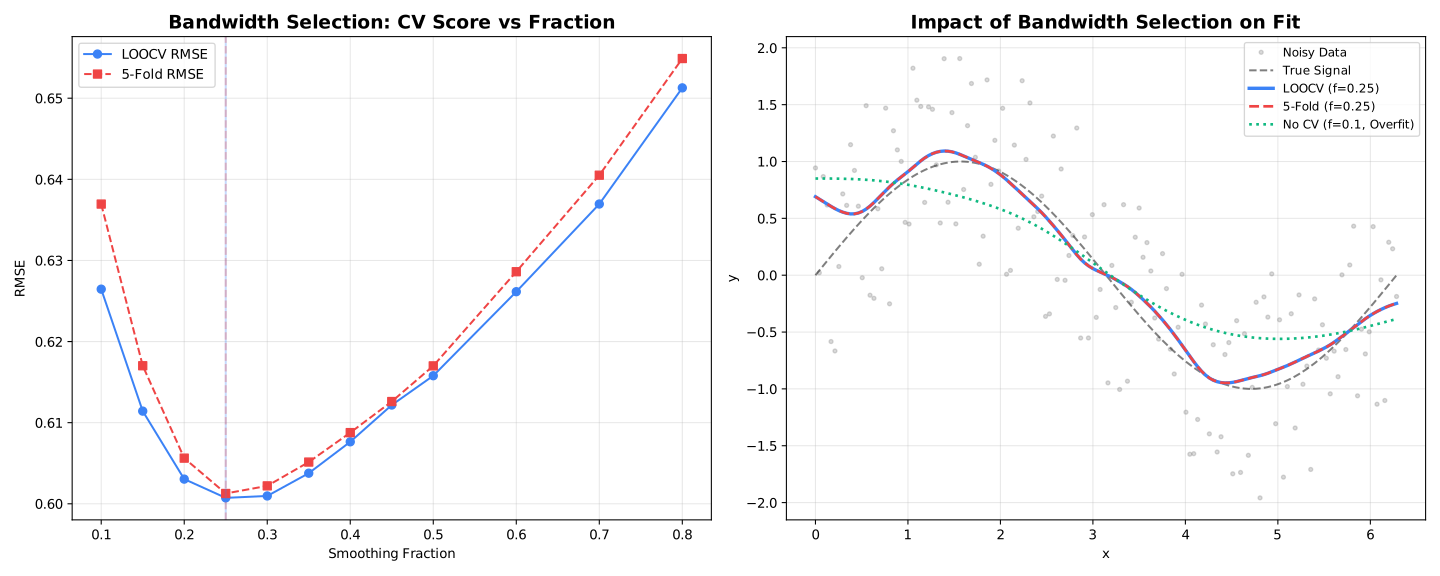
Automated parameter selection via cross-validation.
Overview
Section titled “Overview”Cross-validation helps select optimal parameters (especially fraction) by evaluating performance on held-out data.
K-Fold Cross-Validation
Section titled “K-Fold Cross-Validation”Split data into K folds, train on K-1, validate on 1.
const { Lowess } = require('fastlowess');
const n = 100;const x = Float64Array.from({ length: n }, (_, i) => i * 2 * Math.PI / (n - 1));const y = Float64Array.from(x, xi => Math.sin(xi) + 0.1);
const model = new Lowess({    cv: { method: "kfold", k: 5, fractions: [0.2, 0.3, 0.5, 0.7] }});const result = model.fit(x, y);
console.log("Selected fraction:", result.fraction_used);console.log("CV scores:", result.cv_scores);
Selected fraction: 0.3CV scores: Float64Array(4) [ 0.3442028395147176, 0.34364341192477843, 0.39986523402252316, 0.4760102176301601]Leave-One-Out (LOOCV)
Section titled “Leave-One-Out (LOOCV)”Each point is held out once. Most thorough but slowest.
const { Lowess } = require('fastlowess');
const n = 100;const x = Float64Array.from({ length: n }, (_, i) => i * 2 * Math.PI / (n - 1));const y = Float64Array.from(x, xi => Math.sin(xi) + 0.1);
const model = new Lowess({    cv: { method: "loocv", fractions: [0.2, 0.3, 0.5, 0.7] }});const result = model.fit(x, y);console.log("Fraction used:", result.fraction_used);
Fraction used: 0.2Seeded Randomization
Section titled “Seeded Randomization”Set a seed for reproducible fold assignments:
const fl = require('fastlowess');
const n = 100;const x = Float64Array.from({ length: n }, (_, i) => i * 2 * Math.PI / (n - 1));const y = Float64Array.from(x, xi => Math.sin(xi) + 0.1);
const model = new fl.Lowess({    cv: { method: "kfold", k: 5, fractions: [0.3, 0.5, 0.7] },    seed: 42});const result = model.fit(x, y);console.log("Fraction used:", result.fraction_used);
Fraction used: 0.3Comparison
Section titled “Comparison”| Method | Folds | Speed | Variance | Bias |
|---|---|---|---|---|
| KFold(5) | 5 | Fast | Moderate | Low |
| KFold(10) | 10 | Medium | Lower | Lower |
| LOOCV | N | Slow | Lowest | Lowest |
CV Metrics
Section titled “CV Metrics”Cross-validation uses MSE (Mean Squared Error) by default:
MSE = mean((y_true - y_pred)^2)Lower MSE indicates better fit on held-out data.
Interpreting Results
Section titled “Interpreting Results”const { Lowess } = require('fastlowess');
const n = 100;const x = Float64Array.from({ length: n }, (_, i) => i * 2 * Math.PI / (n - 1));const y = Float64Array.from(x, xi => Math.sin(xi) + 0.1);
// Example outputconst model = new Lowess({ cv: { method: "kfold", k: 5, fractions: [0.1, 0.3, 0.5, 0.7] }});const result = model.fit(x, y);
// Fraction | CV Score (MSE)// 0.1 | 0.0542 ← Undersmoothed// 0.3 | 0.0231 ← Best// 0.5 | 0.0298// 0.7 | 0.0412 ← Oversmoothedconsole.log("Fraction used:", result.fraction_used);Fraction used: 0.3The fraction with lowest CV score is automatically selected.
Availability
Section titled “Availability”| Feature | Batch | Streaming | Online |
|---|---|---|---|
| K-Fold CV | ✓ | ✗ | ✗ |
| LOOCV | ✓ | ✗ | ✗ |
Best Practices
Section titled “Best Practices”- Test a range: Include fractions from 0.1 to 0.9
- Use enough folds: 5-10 folds balance speed and accuracy
- Set a seed: For reproducible results
- Check the curve: CV optimizes MSE, but visual inspection matters