Intervals
Confidence and prediction intervals for uncertainty quantification.
Overview
Section titled “Overview”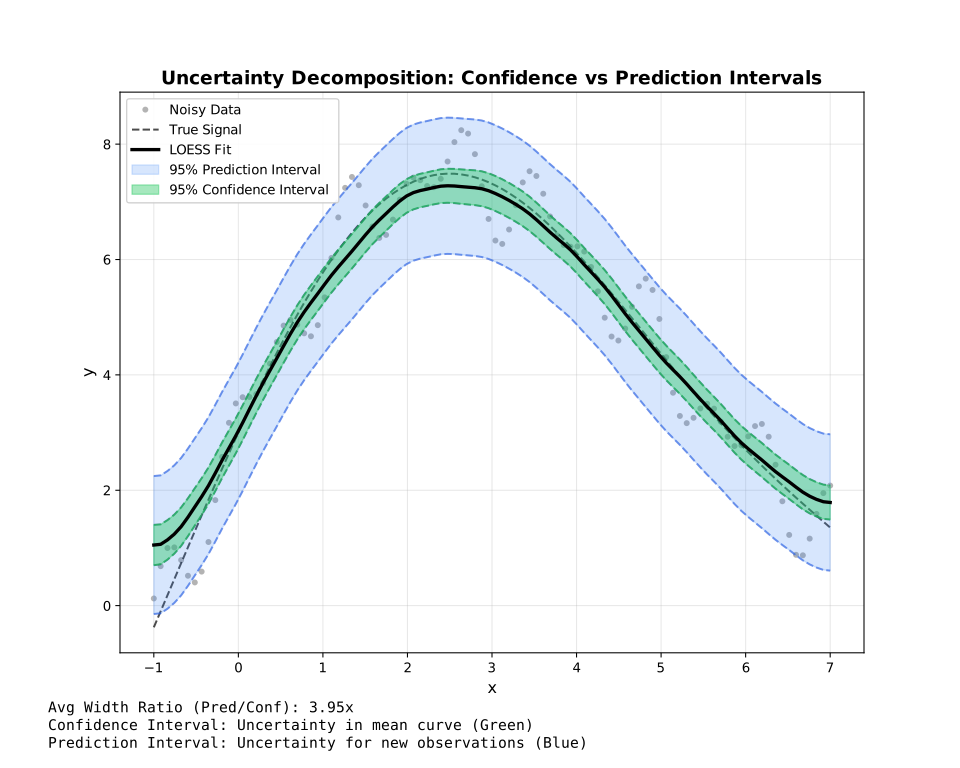
| Type | Represents | Width | Use |
|---|---|---|---|
| Confidence | Uncertainty in mean curve | Narrow | Where is the true trend? |
| Prediction | Uncertainty for new points | Wide | Where will new data fall? |
Confidence Intervals
Section titled “Confidence Intervals”Estimate uncertainty in the smoothed curve itself.
const { Loess } = require('fastloess-wasm');
const n = 100;const x = Float64Array.from({ length: n }, (_, i) => i * 2 * Math.PI / (n - 1));const y = Float64Array.from(x, (xi, i) => Math.sin(xi) + (((i * 7 + 3) % 17) / 17 - 0.5) * 0.6);
const model = new Loess({ fraction: 0.5, confidence_intervals: 0.95 });const result = model.fit(x, y);
result.y.slice(0, 3).forEach((y, i) => {    console.log(`x=${result.x[i].toFixed(4)}: y=${y.toFixed(4)} [${result.confidence_lower[i].toFixed(4)}, ${result.confidence_upper[i].toFixed(4)}]`);});console.log(`... (${result.y.length - 3} more)`);
x=0.0000: y=0.1118 [-0.0078, 0.2313]x=0.0635: y=0.1389 [0.0201, 0.2577]x=0.1269: y=0.1702 [0.0521, 0.2882]... (97 more)Prediction Intervals
Section titled “Prediction Intervals”Estimate where new observations might fall.
const { Loess } = require('fastloess-wasm');
const n = 100;const x = Float64Array.from({ length: n }, (_, i) => i * 2 * Math.PI / (n - 1));const y = Float64Array.from(x, (xi, i) => Math.sin(xi) + (((i * 7 + 3) % 17) / 17 - 0.5) * 0.6);
const model = new Loess({ fraction: 0.5, prediction_intervals: 0.95 });const result = model.fit(x, y);console.log(`Prediction bounds: [${result.prediction_lower[0]}, ${result.prediction_upper[0]}]`);
Prediction bounds: [-0.4048770295448013, 0.6284079607546723]Both Intervals
Section titled “Both Intervals”Request both types simultaneously:
const { Loess } = require('fastloess-wasm');
const n = 100;const x = Float64Array.from({ length: n }, (_, i) => i * 2 * Math.PI / (n - 1));const y = Float64Array.from(x, (xi, i) => Math.sin(xi) + (((i * 7 + 3) % 17) / 17 - 0.5) * 0.6);
const model = new Loess({    fraction: 0.5,    confidence_intervals: 0.95,    prediction_intervals: 0.95});const result = model.fit(x, y);console.log("CI lower[0]:", result.confidence_lower[0].toFixed(4));
CI lower[0]: -0.0078Confidence Levels
Section titled “Confidence Levels”Common levels and their z-values:
| Level | z-value | Interpretation |
|---|---|---|
| 0.90 | 1.645 | 90% of intervals contain true value |
| 0.95 | 1.960 | 95% of intervals contain true value |
| 0.99 | 2.576 | 99% of intervals contain true value |
const { Loess } = require('fastloess-wasm');
const n = 100;const x = Float64Array.from({ length: n }, (_, i) => i * 2 * Math.PI / (n - 1));const y = Float64Array.from(x, (xi, i) => Math.sin(xi) + (((i * 7 + 3) % 17) / 17 - 0.5) * 0.6);
// 99% confidence intervalconst model = new Loess({ confidence_intervals: 0.99 });const result = model.fit(x, y);console.log("CI lower[0]:", result.confidence_lower[0].toFixed(4));
CI lower[0]: 0.0056Standard Errors
Section titled “Standard Errors”Access standard errors directly (available when intervals are computed):
const { Loess } = require('fastloess-wasm');
const n = 100;const x = Float64Array.from({ length: n }, (_, i) => i * 2 * Math.PI / (n - 1));const y = Float64Array.from(x, (xi, i) => Math.sin(xi) + (((i * 7 + 3) % 17) / 17 - 0.5) * 0.6);
const model = new Loess({ confidence_intervals: 0.95 });const result = model.fit(x, y);
result.standard_errors.slice(0, 5).forEach((se, i) => {    console.log(`Point ${i}: SE = ${se.toFixed(4)}`);});console.log(`... (${result.standard_errors.length - 5} more)`);
Point 0: SE = 0.0624Point 1: SE = 0.0622Point 2: SE = 0.0621Point 3: SE = 0.0620Point 4: SE = 0.0619... (95 more)Availability
Section titled “Availability”| Feature | Batch | Streaming | Online |
|---|---|---|---|
| Confidence intervals | ✓ | ✗ | ✗ |
| Prediction intervals | ✓ | ✗ | ✗ |
| Standard errors | ✓ | ✗ | ✗ |