Multivariate LOESS
Smoothing over multiple predictor dimensions simultaneously.
Overview
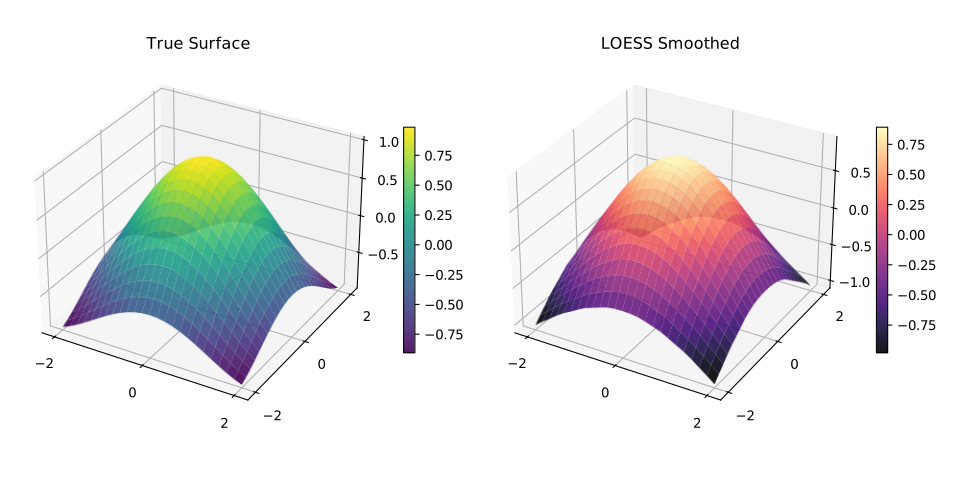
Section titled “Overview”Standard LOESS operates on a single predictor . Setting dimensions > 1 extends the neighbourhood search and local polynomial fit into an -dimensional predictor space, enabling surface smoothing over spatial grids, time–altitude combinations, and similar multi-predictor datasets. x is passed as a flat, row-major array of length y.length * dimensions.
| Dimensions | Use Case | Input Shape |
|---|---|---|
1 | Time series, 1D signal (default) | x: 1-D array |
2 | Spatial surface, 2-predictor model | x: flat array of length n*2, row-major |
3+ | High-dimensional regression | x: flat array of length n*d, row-major |
1D — Standard (Default)
Section titled “1D — Standard (Default)”Single predictor. No configuration required.
const { Loess } = require('fastloess-wasm');
const n = 100;const x = Float64Array.from({ length: n }, (_, i) => i * 2 * Math.PI / (n - 1));const y = Float64Array.from(x, (xi, i) => Math.sin(xi) + (((i * 7 + 3) % 17) / 17 - 0.5) * 0.6);
const model = new Loess({ fraction: 0.3 });const result = model.fit(x, y);console.log("y[0]:", result.y[0].toFixed(4));
y[0]: 0.02812D — Spatial Surface
Section titled “2D — Spatial Surface”Two predictors (e.g., latitude/longitude, time/altitude). Pass a flat, row-major array of length n*2 as x.
const { Loess } = require('fastloess-wasm');
const n = 100;const lat = Float64Array.from({ length: n }, (_, i) => i * 2 * Math.PI / (n - 1));const lon = Float64Array.from({ length: n }, (_, i) => i * 2 * Math.PI / (n - 1));const z = Float64Array.from({ length: n }, (_, i) => Math.sin(lat[i]) + Math.cos(lon[i]) + 0.05);const x2d = Float64Array.from({ length: n * 2 }, (_, k) => k % 2 === 0 ? lat[k >> 1] : lon[k >> 1]);
const model = new Loess({ fraction: 0.3, dimensions: 2 });const result = model.fit(x2d, z);console.log("y[0]:", result.y[0].toFixed(4));
y[0]: 1.26013D and Higher
Section titled “3D and Higher”Three or more predictors. The neighbourhood radius grows in each additional dimension, so a larger fraction (or smaller dataset) is typically needed.
const { Loess } = require('fastloess-wasm');
const n = 100;const x1 = Float64Array.from({ length: n }, (_, i) => i * 2 * Math.PI / (n - 1));const x2 = Float64Array.from({ length: n }, (_, i) => i / (n - 1));const x3 = Float64Array.from({ length: n }, (_, i) => 1 - i / (n - 1));const y = Float64Array.from({ length: n }, (_, i) => Math.sin(x1[i]) + x2[i] - x3[i] + 0.05);const x3d = Float64Array.from({ length: n * 3 }, (_, k) => {    const i = Math.floor(k / 3), d = k % 3;    return d === 0 ? x1[i] : d === 1 ? x2[i] : x3[i];});
const model = new Loess({ fraction: 0.5, dimensions: 3 });const result = model.fit(x3d, y);console.log("y[0]:", result.y[0].toFixed(4));
y[0]: -0.5448Distance Metrics for Multivariate Data
Section titled “Distance Metrics for Multivariate Data”When dimensions > 1 you can also control how inter-point distances are computed.
| Metric | Description | When to Use |
|---|---|---|
"normalized" | Each dimension scaled to unit range (default) | Predictors on different scales |
"euclidean" | Raw Euclidean distance | Predictors already on same scale |
"minkowski:p" | Generalised Minkowski () norm | Custom distance geometry |
"weighted" | Per-dimension weighted Euclidean | Domain-specific importance |
See API Reference for the full list of options per language.