How Custom Weights Work
Standard LOWESS assigns equal prior trust to all observations. Custom weights let you override this assumption point by point — before any distance or robustness weighting is applied.
The effective weight of observation in a local fit centred at is:
where is the distance kernel, is the local bandwidth, and is the robustness weight from the current iteration.
Batch adapter only:
custom_weightsapplies in Batch mode. It is silently ignored in Streaming and Online adapters.
When to Use Custom Weights
| Situation | Recommended weight |
|---|---|
| Point known to be erroneous |
0.0 — fully excluded |
| Unreliable sensor / low precision | 0.1 – 0.5 |
| Standard observation |
1.0 (default) |
| Carefully calibrated measurement | > 1.0 |
| Measurement uncertainty |
Custom Weights vs. Robustness Iterations
Both mechanisms handle unreliable data, but they serve different purposes:
| Custom Weights | Robustness Iterations | |
|---|---|---|
| When known | Before fitting | Computed from residuals |
| Knowledge required | Prior knowledge of quality | None — data-driven |
| Effect | Fixed throughout fit | Adapts each iteration |
| Use case | Known bad sensors | Unknown outlier contamination |
They compose: you can use both simultaneously. Custom weights suppress a priori bad points; robustness iterations then handle any residual outliers that remain.
Basic Usage
Suppress a Known Outlier
Set the weight to 0 at the bad point — it is excluded
from every local fit that would otherwise include it.
library(rfastlowess)

x <- 1:10
y <- x * 2.0
y[6] <- 100.0              # spike at index 6

weights <- rep(1.0, 10)
weights[6] <- 0.0          # exclude the spike

model <- Lowess(fraction = 0.5, iterations = 0L)
result <- fit(model, x, y, custom_weights = weights)
cat("Smoothed y[0]:", result$y[1], "\n")
#> Smoothed y[0]: 2.572621
Emphasize Important Points
Assign high weights to measurements you trust most — calibration standards, reference instruments, or low-noise observations.
library(rfastlowess)
x <- seq(0, 2 * pi, length.out = 100)
y <- sin(x) + 0.1
calibration_indices <- c(6, 21, 41, 61, 81)

weights <- rep(1.0, length(x))
weights[calibration_indices] <- 10.0

model <- Lowess(fraction = 0.5)
result <- fit(model, x, y, custom_weights = weights)
cat("Smoothed y[0]:", result$y[1], "\n")
#> Smoothed y[0]: 0.3229811
Propagate Measurement Uncertainty
If each observation has a known standard deviation , set to give the fit information-theoretically optimal weighting.
library(rfastlowess)
x <- seq(0, 2 * pi, length.out = 100)
y <- sin(x) + 0.1
sigma <- 0.1 + (seq_along(x) %% 4) * 0.1

weights <- 1 / sigma^2
model <- Lowess(fraction = 0.5)
result <- fit(model, x, y, custom_weights = weights)

plot(x, y, pch = 16, cex = 0.5 + weights / max(weights),
    col = "gray", main = "Inverse-Variance Weighted LOWESS")
lines(result$x, result$y, col = "blue", lwd = 2)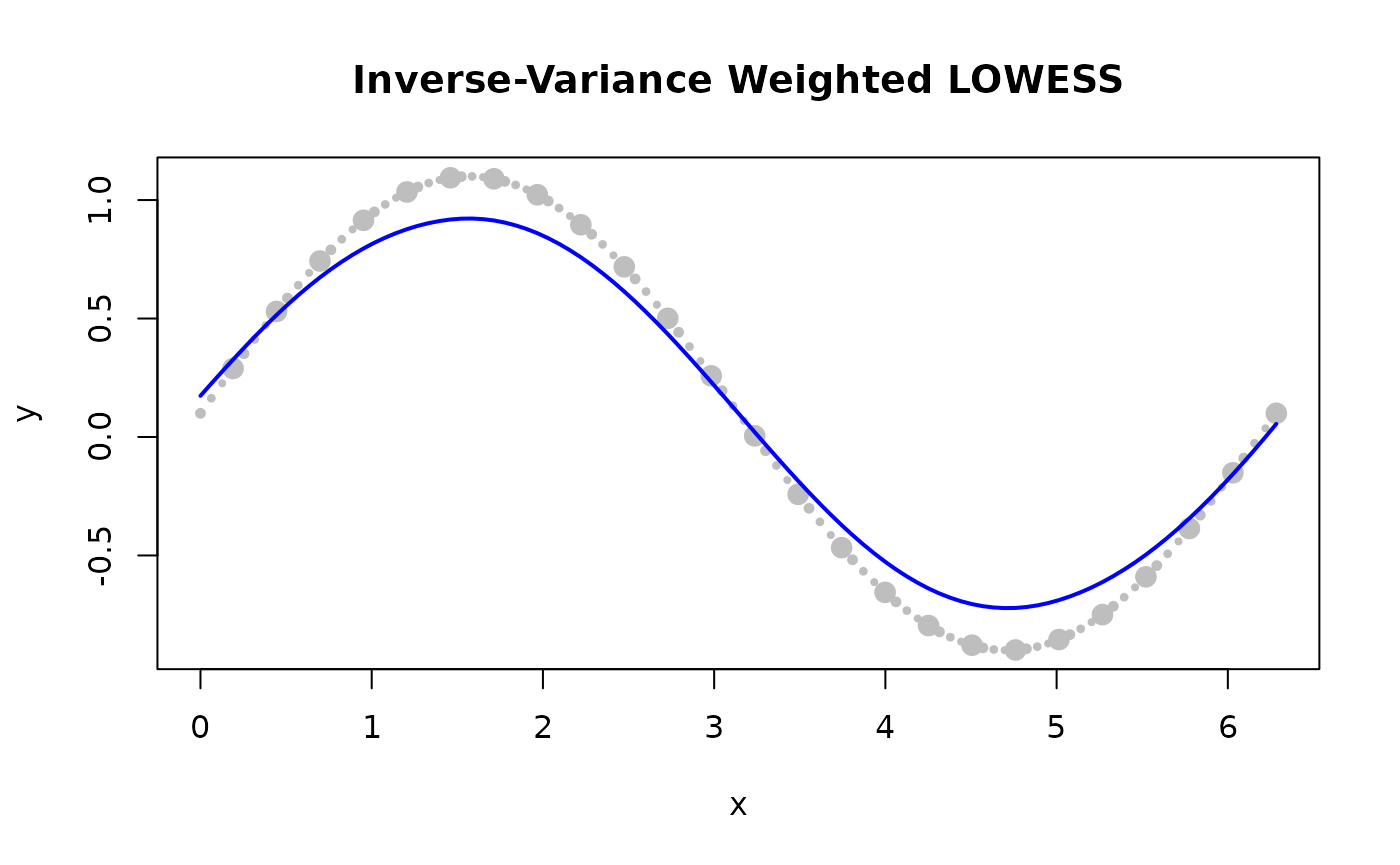
cat("Smoothed y[0]:", result$y[1], "\n")
#> Smoothed y[0]: 0.1737171
Combined with Robustness Iterations
Custom weights and robustness iterations compose naturally: use custom weights for known bad points and robustness for unknown contamination.
library(rfastlowess)
x <- 0:19
y <- x * 1.5
y[4]  <- -50.0   # known bad
y[13] <- 80.0    # unknown outlier

weights <- rep(1.0, 20)
weights[4] <- 0.0

model <- Lowess(fraction = 0.4, iterations = 3)
result <- fit(model, x, y, custom_weights = weights)
cat("Smoothed y[0]:", result$y[1], "\n")
#> Smoothed y[0]: 0.8612265
Validation Rules
| Rule | Effect |
|---|---|
Length must equal n
|
Error at fit time if mismatched |
| All values must be ≥ 0 | Negative weights are rejected |
| All-zero weight vector | Error: no points remain for any local fit |
Uniform weights (1.0 everywhere) |
Identical result to omitting weights |
Zero-weight windows: If a local neighbourhood contains only zero-weight points, the fit at that centre point falls back to the behaviour specified by
zero_weight_fallback(default:"use_local_mean").
See Also
- Robustness — adaptive outlier downweighting via IRLS
-
?Lowess— full parameter reference
sessionInfo()
#> R version 4.6.1 (2026-06-24)
#> Platform: x86_64-pc-linux-gnu
#> Running under: Ubuntu 24.04.5 LTS
#>
#> Matrix products: default
#> BLAS:   /usr/lib/x86_64-linux-gnu/openblas-pthread/libblas.so.3
#> LAPACK: /usr/lib/x86_64-linux-gnu/openblas-pthread/libopenblasp-r0.3.26.so;  LAPACK version 3.12.0
#>
#> locale:
#>  [1] LC_CTYPE=C.UTF-8       LC_NUMERIC=C           LC_TIME=C.UTF-8
#>  [4] LC_COLLATE=C.UTF-8     LC_MONETARY=C.UTF-8    LC_MESSAGES=C.UTF-8
#>  [7] LC_PAPER=C.UTF-8       LC_NAME=C              LC_ADDRESS=C
#> [10] LC_TELEPHONE=C         LC_MEASUREMENT=C.UTF-8 LC_IDENTIFICATION=C
#>
#> time zone: UTC
#> tzcode source: system (glibc)
#>
#> attached base packages:
#> [1] stats     graphics  grDevices utils     datasets  methods   base
#>
#> other attached packages:
#> [1] rfastlowess_5.0.0
#>
#> loaded via a namespace (and not attached):
#>  [1] digest_0.6.39     desc_1.4.3        R6_2.6.1          fastmap_1.2.0
#>  [5] xfun_0.61         cachem_1.1.0      knitr_1.52        htmltools_0.5.9
#>  [9] rmarkdown_2.32    lifecycle_1.0.5   cli_3.6.6         sass_0.4.10
#> [13] pkgdown_2.2.1     textshaping_1.0.5 jquerylib_0.1.4   systemfonts_1.3.2
#> [17] compiler_4.6.1    tools_4.6.1       ragg_1.5.2        bslib_0.12.0
#> [21] evaluate_1.0.5    yaml_2.3.12       otel_0.2.0        jsonlite_2.0.0
#> [25] rlang_1.3.0       fs_2.1.0          htmlwidgets_1.6.4