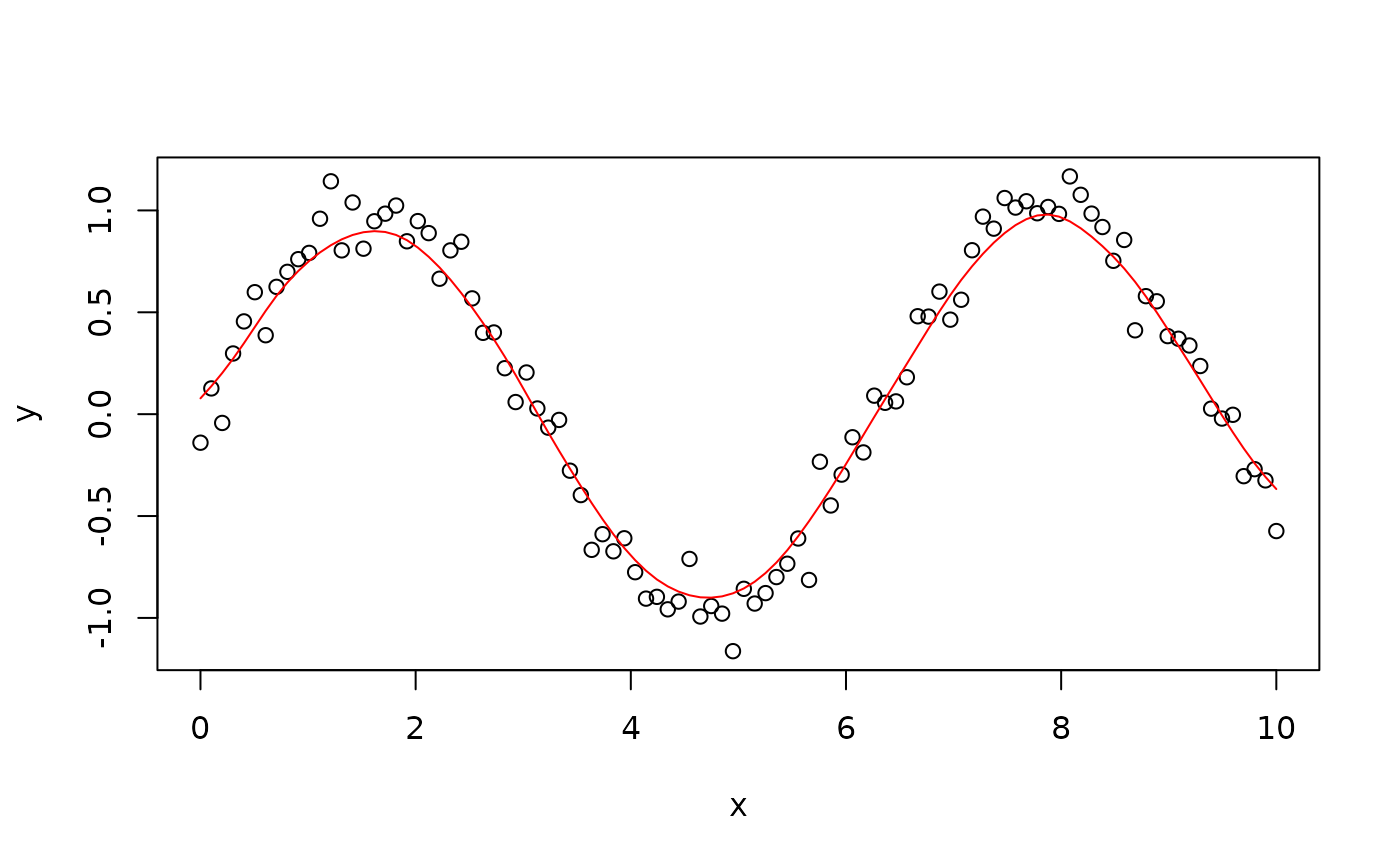
Create a stateful LOWESS model for batch smoothing. This is the default mode: it processes the entire dataset at once and supports every feature (confidence/prediction intervals, cross-validation, GPU backend).
Usage
Lowess(
    fraction = 0.67,
    ...,
    iterations = 3L,
    weight_function = "tricube",
    robustness_method = "bisquare",
    delta = NULL,
    zero_weight_fallback = "use_local_mean",
    boundary_policy = "extend",
    scaling_method = "mad",
    auto_converge = NULL,
    missing = "error",
    parallel = TRUE,
    backend = "cpu",
    outputs = NULL,
    intervals = NULL,
    cv = NULL,
    seed = NULL,
    retain_model = FALSE
)
Arguments
- fraction
Smoothing fraction, greater than 0 and up to 1. Default: 0.67.
- ...
Not used; forces all subsequent arguments to be named.
- iterations
Number of robustness iterations, between 0 and 1000 (inclusive). Default: 3.
- weight_function
Kernel weight function. One of
"tricube"(default),"gaussian","uniform"(alias:"boxcar"),"cosine","epanechnikov","biweight"(alias:"bisquare"), or"triangle"(alias:"triangular").- robustness_method
Outlier downweighting method:
"bisquare"(default; alias:"biweight"),"huber", or"talwar".- delta
Interpolation distance threshold, as a non-negative fraction of the x range; points within
deltaof each other on x share the same local fit.NULL(default) sets it automatically to 1/100th of the x range.- zero_weight_fallback
Fallback policy when all robustness weights drop to zero:
"use_local_mean"(default; aliases:"local_mean","mean"),"return_original"(alias:"original"), or"return_none"(alias:"none").- boundary_policy
Boundary handling strategy:
"extend"(default; alias:"pad"),"reflect"(alias:"mirror"),"zero", or"noboundary"(alias:"none").- scaling_method
Residual scale estimation for robustness weights:
"mad"(default; alias:"median_absolute_deviation"),"mar"(alias:"median_absolute_residual"), or"mean"(alias:"mean_absolute_residual").- auto_converge
Convergence tolerance for early stopping of robustness iterations.
NULL(default) disables early stopping.- missing
Policy for non-finite (NaN/Infinity) values in input data:
"error"(default) raises an error,"drop"silently removes affected observations before fitting.- parallel
Logical; enable parallel processing. Default:
TRUE.- backend
Execution backend:
"cpu"(default) or"gpu". GPU support requires the package to be built locally withWITH_GPU=1(seebindings/r/Makefile) and a Vulkan/Metal/DX12-capable GPU driver; not available in released CRAN/Bioconductor binaries.- outputs
Character vector selecting optional output components:
"se"(standard errors),"diagnostics","residuals","weights"(robustness weights),"derivative", and/or"sorted".NULL(default) returns only the core result (x,y, and fit metadata).- intervals
Interval options, created with
intervals_opts(or a named list with any ofconfidence,prediction,bootstrap): e.g.intervals = intervals_opts(confidence = 0.90, prediction = 0.99, bootstrap = 200). Confidence and prediction coverage levels are independent and may differ.NULL(default) disables intervals.- cv
Cross-validation options, created with
cv_opts: e.g.cv = cv_opts(method = "kfold", k = 5, fractions = c(0.2, 0.3, 0.5)).NULL(default) disables cross-validation.- seed
Non-negative whole-number seed shared by cross-validation and bootstrap resampling for reproducible results. When cross-validation is unavailable, it controls bootstrap resampling only.
NULL(default) uses a random seed.- retain_model
Logical; if
TRUE, retain the fitted model's training data, enablingpredict.Lowessfor out-of-sample prediction. Default:FALSE.
Details
Best suited when the dataset fits in memory and you need intervals,
cross-validation, or diagnostics. For datasets that don't fit in memory or
arrive in chunks, see StreamingLowess; for point-by-point
real-time data, see OnlineLowess.
When "diagnostics" is selected, residual_sd is the robust
residual scale estimate (1.4826 * MAD).
fraction is the most important parameter: it controls the size of the
local neighbourhood used at each point.
| Range | Effect | Use case |
| 0.1-0.3 | Fine detail | Rapidly changing signals |
| 0.3-0.5 | Balanced | General purpose |
| 0.5-0.7 | Heavy smoothing | Noisy data |
| 0.7-1.0 | Very smooth | Trend extraction |