Robustness
Outlier handling through iterative reweighting.
How Robustness Works
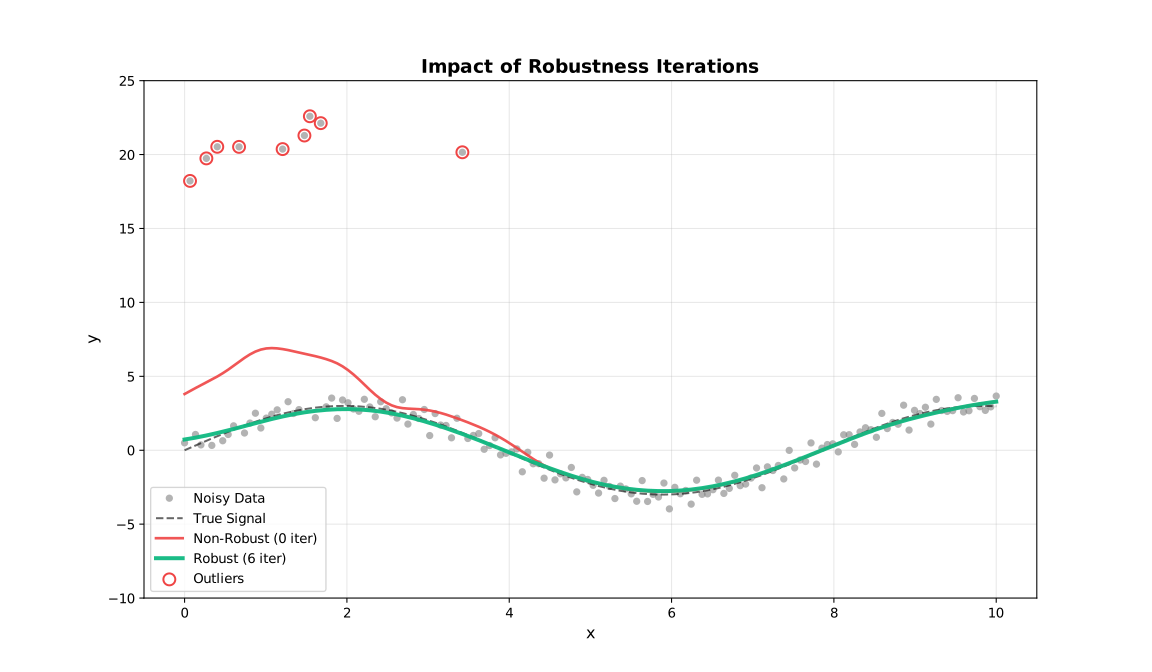
Standard LOWESS can be biased by outliers. Robustness iterations downweight points with large residuals:
-
Fit initial LOWESS
-
Compute residuals
-
Assign robustness weights (large residuals → low weight)
-
Refit using combined distance × robustness weights
-
Repeat steps 2–4
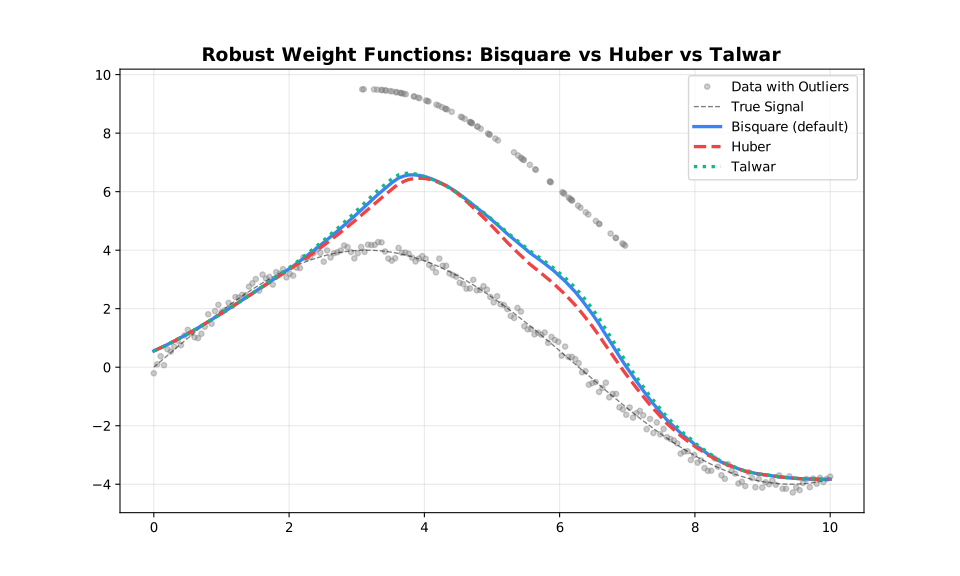
Robustness Methods
Bisquare (Default)
Smooth downweighting. Points transition gradually from full weight to zero.
Use when: General purpose, balanced approach.
import fastlowess.Lowess;
import fastlowess.Options;
import fastlowess.Result;

public class Example {
    public static void main(String[] args) {
        int n = 100;
        double[] x = new double[n];
        double[] y = new double[n];
        for (int i = 0; i < n; i++) {
            x[i] = i * 2 * Math.PI / (n - 1);
            y[i] = Math.sin(x[i]) + 0.1;
        }

        Options options = Options.builder()
                .iterations(3)
                .robustnessMethod("bisquare")
                .build();

        try (Lowess model = new Lowess(options)) {
            Result result = model.fit(x, y);
            System.out.println("First smoothed value (bisquare robustness): " + result.y()[0]);
        }
    }
}
First smoothed value (bisquare robustness): 0.3808839002538159Huber
Linear penalty beyond threshold. Less aggressive than Bisquare.
Use when: Moderate outliers, want to retain some influence.
import fastlowess.Lowess;
import fastlowess.Options;
import fastlowess.Result;

public class Example {
    public static void main(String[] args) {
        int n = 100;
        double[] x = new double[n];
        double[] y = new double[n];
        for (int i = 0; i < n; i++) {
            x[i] = i * 2 * Math.PI / (n - 1);
            y[i] = Math.sin(x[i]) + 0.1;
        }

        Options options = Options.builder()
                .iterations(3)
                .robustnessMethod("huber")
                .build();

        try (Lowess model = new Lowess(options)) {
            Result result = model.fit(x, y);
            System.out.println("First smoothed value (huber robustness): " + result.y()[0]);
        }
    }
}
First smoothed value (huber robustness): 0.3789215614787963Talwar
Hard threshold. Points are either fully weighted or completely excluded.
Use when: Extreme outliers, want binary exclusion.
import fastlowess.Lowess;
import fastlowess.Options;
import fastlowess.Result;

public class Example {
    public static void main(String[] args) {
        int n = 100;
        double[] x = new double[n];
        double[] y = new double[n];
        for (int i = 0; i < n; i++) {
            x[i] = i * 2 * Math.PI / (n - 1);
            y[i] = Math.sin(x[i]) + 0.1;
        }

        Options options = Options.builder()
                .iterations(3)
                .robustnessMethod("talwar")
                .build();

        try (Lowess model = new Lowess(options)) {
            Result result = model.fit(x, y);
            System.out.println("First smoothed value (talwar robustness): " + result.y()[0]);
        }
    }
}
First smoothed value (talwar robustness): 0.3787793754241902Comparison
| Method | Transition | Aggressiveness | Use Case |
|---|---|---|---|
Bisquare |
Smooth |
Moderate |
General purpose |
Huber |
Gradual |
Mild |
Preserve influence |
Talwar |
Hard |
Strong |
Extreme contamination |
Detecting Outliers
Use robustness weights to identify potential outliers:
import fastlowess.Lowess;
import fastlowess.Options;
import fastlowess.Result;

public class Example {
    public static void main(String[] args) {
        double[] x = { 1.0, 2.0, 3.0, 4.0, 5.0, 6.0 };
        double[] y = { 2.0, 4.0, 6.0, 50.0, 10.0, 12.0 }; // 50.0 is an outlier

        Options options = Options.builder()
                .fraction(0.7)
                .iterations(3)
                .outputs("weights")
                .build();

        try (Lowess model = new Lowess(options)) {
            Result result = model.fit(x, y);
            double[] weights = result.robustnessWeights().orElseThrow();
            for (int i = 0; i < weights.length; i++) {
                if (weights[i] < 0.5) {
                    System.out.printf("Point %d is likely an outlier (weight: %.3f)%n", i, weights[i]);
                }
            }
        }
    }
}
Point 3 is likely an outlier (weight: 0.000)Scale Estimation
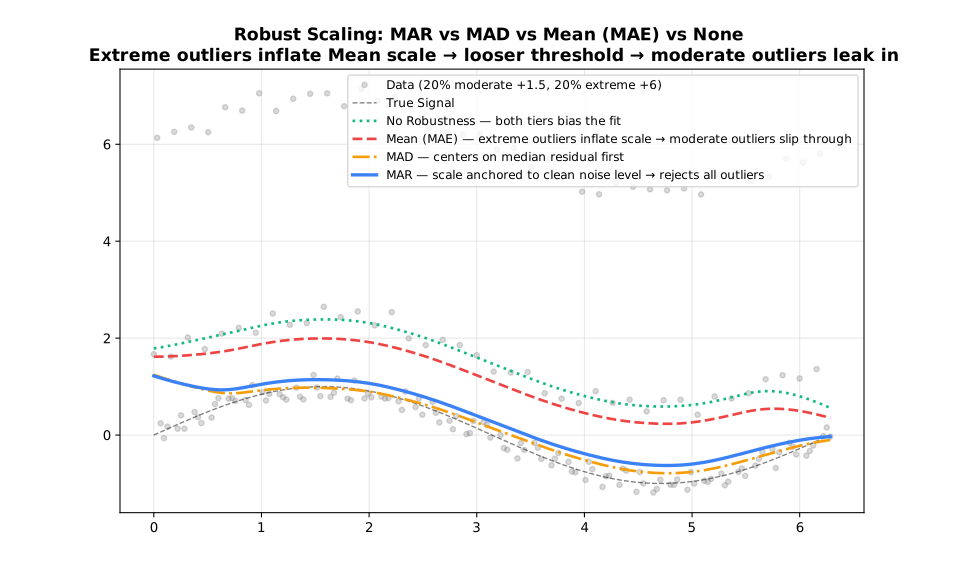
Residuals are scaled before computing robustness weights. Two methods:
| Method | Formula | Robustness |
|---|---|---|
MAD |
|
Very robust (default) |
MAR |
|
Robust, uncentered |
Mean |
|
Less robust, fastest |
import fastlowess.Lowess;
import fastlowess.Options;
import fastlowess.Result;

public class Example {
    public static void main(String[] args) {
        int n = 100;
        double[] x = new double[n];
        double[] y = new double[n];
        for (int i = 0; i < n; i++) {
            x[i] = i * 2 * Math.PI / (n - 1);
            y[i] = Math.sin(x[i]) + 0.1;
        }

        Options options = Options.builder()
                .iterations(3)
                .scalingMethod("mad")
                .build();

        try (Lowess model = new Lowess(options)) {
            Result result = model.fit(x, y);
            System.out.println("First smoothed value (mad scaling): " + result.y()[0]);
        }
    }
}
First smoothed value (mad scaling): 0.3808839002538159Auto-Convergence
Stop iterations early when weights stabilize:
|
Performance: Auto-convergence can significantly reduce computation when weights stabilize before reaching max iterations. |
import fastlowess.Lowess;
import fastlowess.Options;
import fastlowess.Result;

public class Example {
    public static void main(String[] args) {
        int n = 100;
        double[] x = new double[n];
        double[] y = new double[n];
        for (int i = 0; i < n; i++) {
            x[i] = i * 2 * Math.PI / (n - 1);
            y[i] = Math.sin(x[i]) + 0.1;
        }

        Options options = Options.builder()
                .iterations(10)
                .autoConverge(1e-6)
                .build();

        try (Lowess model = new Lowess(options)) {
            Result result = model.fit(x, y);
            System.out.println("First smoothed value (auto-converge): " + result.y()[0]);
        }
    }
}
First smoothed value (auto-converge): 0.3808832251069815All examples above use the same 100-point noisy sine wave (see Weight Functions for the generation code), except the outlier-detection example above, which uses a small dataset with a deliberate spike.