OnlineLoess — Node.js API Reference
See also: fastLoess
When to Use
Section titled “When to Use”- Data arrives incrementally (sensors, streams)
- Need real-time smoothed values
- Fixed memory budget
OnlineLoess
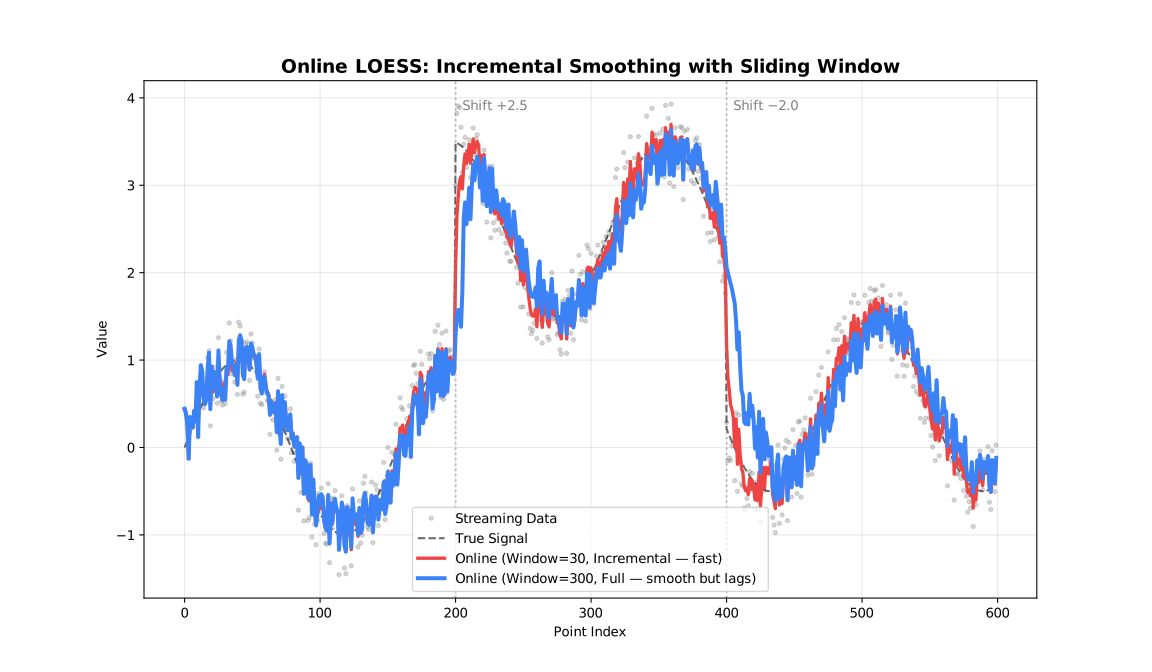
Section titled “OnlineLoess”The OnlineLoess class updates the model incrementally with new data points.
Constructor:
const { OnlineLoess } = require('fastloess');
const online = new OnlineLoess({ fraction: 0.5 }, { window_capacity: 50, min_points: 3 });// Feed enough points to pass min_points thresholdfor (let i = 0; i < 4; i++) {    const result = online.add_point(i, Math.sin(i * 0.5));    if (result !== null) console.log("Online smoothed at x=" + i + ":", result.y.toFixed(4));}
Online smoothed at x=2: 0.8415Online smoothed at x=3: 0.9975options: An object containingOnlineSmoothOptionsfields (a subset of the BatchLoessOptionsfields — see below).onlineOptions: An object containingOnlineOptionsfields.
add_point(x, y)
Section titled “add_point(x, y)”Adds a single point to the sliding window and returns an OnlineOutput once enough points are available, or null while the window is still filling.
For multivariate models, set dimensions in OnlineSmoothOptions and call add_point_vector() with a Float64Array containing one coordinate per dimension. The scalar add_point() method remains available for one-dimensional models.
const { OnlineLoess } = require('fastloess');
const n = 100;const x = Float64Array.from({ length: n }, (_, i) => i * 2 * Math.PI / (n - 1));const y = Float64Array.from(x, xi => Math.sin(xi) + 0.1);
const online = new OnlineLoess({ fraction: 0.5 }, { window_capacity: 50, min_points: 3 });
// Returns null until min_points (3) are reachedonline.add_point(x[0], y[0]);  // nullonline.add_point(x[1], y[1]);  // null
// Returns OnlineOutput once enough points are availableconst result = online.add_point(x[2], y[2]);console.log("Smoothed y:", result.y);
Smoothed y: 0.22659245357374927For multivariate models, configure dimensions and pass each coordinate as a
Float64Array to add_point_vector:
const { OnlineLoess } = require('fastloess');
const online2d = new OnlineLoess(    { dimensions: 2, surface_mode: 'direct', outputs: ['gradient'] },    { window_capacity: 10, min_points: 3 });const output = online2d.add_point_vector(new Float64Array([0.5, 1.25]), 2.0);
Use add_point_weighted(x, y, weight) or add_point_vector_weighted(x, y, weight) to provide a finite non-negative case weight. window_diagnostics() computes metrics for the current window on demand; predict_window(newX, options) predicts from a fresh fit of that bounded window.
Options Structures
Section titled “Options Structures”OnlineSmoothOptions
Section titled “OnlineSmoothOptions”| Field | Type | Default | Description |
|---|---|---|---|
fraction | number | 0.67 | Smoothing fraction (bandwidth) |
iterations | number | 0 | Number of robustifying iterations; positive values require update_mode = "full" |
weight_function | string | "tricube" | Weight function name |
robustness_method | string | "bisquare" | Robustness method name |
degree | string | "linear" | Polynomial degree of local fit |
dimensions | number | 1 | Number of predictor dimensions; multivariate updates use add_point_vector() |
distance_metric | string | "normalized" | Distance metric; use "minkowski:p" for custom p |
weighted_metric_weights | number[] | null | Per-dimension weights (used when distance_metric = "weighted") |
surface_mode | string | "interpolation" | Surface computation mode |
cell | number | null | Cell size for interpolation grid (smaller → more vertices, higher accuracy) |
interpolation_vertices | number | null | Number of interpolation vertices |
zero_weight_fallback | string | "use_local_mean" | Zero-weight handling strategy |
boundary_policy | string | "extend" | Boundary handling policy |
boundary_degree_fallback | boolean | null | Fall back to lower polynomial degree at boundaries when higher degrees fail |
scaling_method | string | "mad" | Residual scaling method |
auto_converge | number | null | Auto-convergence tolerance |
missing | string | "error" | Policy for non-finite (NaN/Inf) values in each point |
outputs | string[] | [] | Optional fields: "weights", "gradient" (or "derivative"), "se" |
intervals | { confidence?: number; prediction?: number } | disabled | Grouped confidence and prediction coverage levels. |
Cross-validation, "sorted" output, "diagnostics" output, "residuals" output, and parallel are Batch-only (or Batch/Streaming-only) and not available here; see fastLoess for those. Online always runs sequentially.
OnlineOptions
Section titled “OnlineOptions”| Field | Type | Default | Description |
|---|---|---|---|
window_capacity | number | 1000 | Max points in sliding window |
min_points | number | 2 | Min points before smoothing starts |
update_mode | string | "incremental" | Update mode ("full" or "incremental") |
Options
Section titled “Options”fraction
Section titled “fraction”fraction is the most important parameter: it controls the size of the local neighbourhood used at each point.
| Range | Effect | Use case |
|---|---|---|
| 0.1-0.3 | Fine detail | Rapidly changing signals |
| 0.3-0.5 | Balanced | General purpose |
| 0.5-0.7 | Heavy smoothing | Noisy data |
| 0.7-1.0 | Very smooth | Trend extraction |
iterations
Section titled “iterations”iterations controls robustness to outliers, at the cost of speed.
| Value | Effect | Performance |
|---|---|---|
| 0 | No robustness | Fastest |
| 1-3 | Moderate | Recommended |
| 4-6 | Strong | Contaminated data |
| 7+ | Very strong | Heavy outliers |
weight_function
Section titled “weight_function”See: Weight Functions
"tricube"(default)"epanechnikov""gaussian""uniform"(alias:"boxcar")"biweight"(alias:"bisquare")"triangle"(alias:"triangular")"cosine"
robustness_method
Section titled “robustness_method”See: Robustness
"bisquare"(default; alias:"biweight")"huber""talwar"
degree
Section titled “degree”See: Polynomial Degree
"constant"or"0"(degree 0)"linear"or"1"(default, degree 1)"quadratic"or"2"(degree 2)"cubic"or"3"(degree 3)"quartic"or"4"(degree 4)
dimensions
Section titled “dimensions”See: Multivariate LOESS
For multivariate models, set dimensions and pass one coordinate per dimension to add_point_vector().
distance_metric
Section titled “distance_metric”See: Multivariate LOESS
"normalized"(default — scales each dimension by its range; alias:"norm")"euclidean"(alias:"euclid")"manhattan"(alias:"l1")"chebyshev"(alias:"linf")"minkowski"(use"minkowski:p"string for custom exponent, e.g."minkowski:3")"weighted"plusweighted_metric_weightsfor per-dimension scaling (alias:"weighted_euclidean")
weighted_metric_weights
Section titled “weighted_metric_weights”See: Multivariate LOESS
Per-dimension weights, one per dimension declared in dimensions. Only used when distance_metric = "weighted"; setting distance_metric = "weighted" without providing this raises an error.
null(default) — has no effect unlessdistance_metric = "weighted"is set- A
number[]of per-dimension weights, required whendistance_metric = "weighted"
surface_mode
Section titled “surface_mode”See: Polynomial Degree
Controls whether the local polynomial is evaluated at every query point or at a sparser grid of anchor vertices with Hermite cubic interpolation in between.
| Mode | Behavior | Speed | Accuracy |
|---|---|---|---|
"interpolation" (default) | Evaluate at vertices, interpolate between | Faster | Slight approximation |
"direct" | Evaluate at every query point | Slower | Full precision |
Cell size for the interpolation grid, as a fraction of the data range. Smaller values place more vertices (denser grid), improving accuracy at the cost of speed. Only applies when surface_mode = "interpolation".
null(default) — uses the library default (0.2)- Any number in
(0, 1]
interpolation_vertices
Section titled “interpolation_vertices”Caps the maximum number of interpolation vertices, overriding the count implied by cell. Only applies when surface_mode = "interpolation".
null(default) — uses the library default (no explicit cap)- Any integer
>= 1
zero_weight_fallback
Section titled “zero_weight_fallback”Behavior when all neighborhood weights are zero:
| Option | Behavior |
|---|---|
"use_local_mean" (default; aliases: "local_mean", "mean") | Use the mean of the neighborhood |
"return_original" (alias: "original") | Return the original y value |
"return_none" (alias: "none") | Return NaN |
boundary_policy
Section titled “boundary_policy”See: Boundary Handling
"extend"(default; alias:"pad")"reflect"(alias:"mirror")"zero""noboundary"(alias:"none")
boundary_degree_fallback
Section titled “boundary_degree_fallback”Whether to reduce the polynomial degree at boundary vertices when the requested degree can’t be fit there (e.g., not enough neighbours). Only applies when surface_mode = "interpolation".
null(default) — uses the library default (enabled)true— falls back to a lower degree at boundariesfalse— raises an error instead of silently falling back
scaling_method
Section titled “scaling_method”See: Scaling Methods
"mad"(default; alias:"median_absolute_deviation")"mar"(alias:"median_absolute_residual")"mean"(alias:"mean_absolute_residual")
auto_converge
Section titled “auto_converge”See: Robustness
Convergence tolerance for early stopping of robustness iterations. null (default) disables early stopping.
missing
Section titled “missing”Policy for handling a non-finite (NaN/Inf) x or y value passed to add_point:
| Option | Behavior |
|---|---|
"error" (default) | Throw an error |
"drop" | Silently ignore the point — add_point returns null instead of adding it to the window |
window_capacity
Section titled “window_capacity”Maximum number of most recent points kept in the sliding window; older points are evicted as new ones arrive. Each add_point() call costs O(window_capacity) rather than growing with total history.
min_points
Section titled “min_points”Minimum number of points required before add_point() starts returning smoothed output (rather than null).
update_mode
Section titled “update_mode”See: Execution Modes
| Mode | Alias | Behavior | Speed |
|---|---|---|---|
"incremental" (default) | "single" | Update only affected fits | Faster |
"full" | "resmooth" | Recompute entire window | More accurate |
outputs: se
Section titled “outputs: se”Include the standard error for the latest point in the result (OnlineOutput.standard_error). Same update_mode = "full" requirement as intervals.confidence.
outputs: weights
Section titled “outputs: weights”Include the robustness weight for the latest point (from the last robustness iteration) in the result.
outputs: gradient
Section titled “outputs: gradient”Each local polynomial fit (degree >= linear) already computes per-dimension coefficients internally; this exposes the latest point’s gradient (dimensions values) in OnlineOutput.gradient at effectively no extra computation cost. Only supported when surface_mode is "direct" — throws instead of silently leaving gradient as null if requested under the default "interpolation" mode. Omitted by default.
intervals.confidence
Section titled “intervals.confidence”See: Intervals
Confidence level for the confidence interval around the mean response (e.g. 0.95). Only computed under update_mode = "full" — throws at construction time if set (or "se" output/intervals.prediction is set) while update_mode is left at its default "incremental", since incremental updates never compute standard errors. null (default) disables confidence intervals.
intervals.prediction
Section titled “intervals.prediction”See: Intervals
Confidence level for the prediction interval for new observations (e.g. 0.95). Same update_mode = "full" requirement as intervals.confidence. null (default) disables prediction intervals.
Result Structure
Section titled “Result Structure”OnlineOutput
Section titled “OnlineOutput”Returned by add_point() once the window has enough points (null until then).
| Field | Type | Description |
|---|---|---|
y | number | Smoothed value for the latest point |
standard_error | number | null | Standard error, if "se" output/intervals.confidence/intervals.prediction was set and update_mode = "full" |
residual | number | null | Residual y − smoothed; always present (there is no "residuals" output option for Online) |
robustness_weight | number | null | Robustness weight, if "weights" output was set |
iterations_used | number | null | Robustness iterations performed |
confidence_lower / confidence_upper | number | null | Confidence interval bounds, if intervals.confidence was set and update_mode = "full" |
prediction_lower / prediction_upper | number | null | Prediction interval bounds, if intervals.prediction was set and update_mode = "full" |
gradient | number[] | null | Latest point’s local fit gradient (dimensions values), if "gradient" output was set |
There is no Diagnostics object or "diagnostics" output option for OnlineLoess: OnlineOutput carries no diagnostics field, since diagnostics like RMSE/R² need more than one point’s worth of history to be meaningful.