Kernel functions for distance weighting.
Overview#
Weight functions (kernels) determine how neighboring points contribute to each local fit. Points closer to the target receive higher weights.
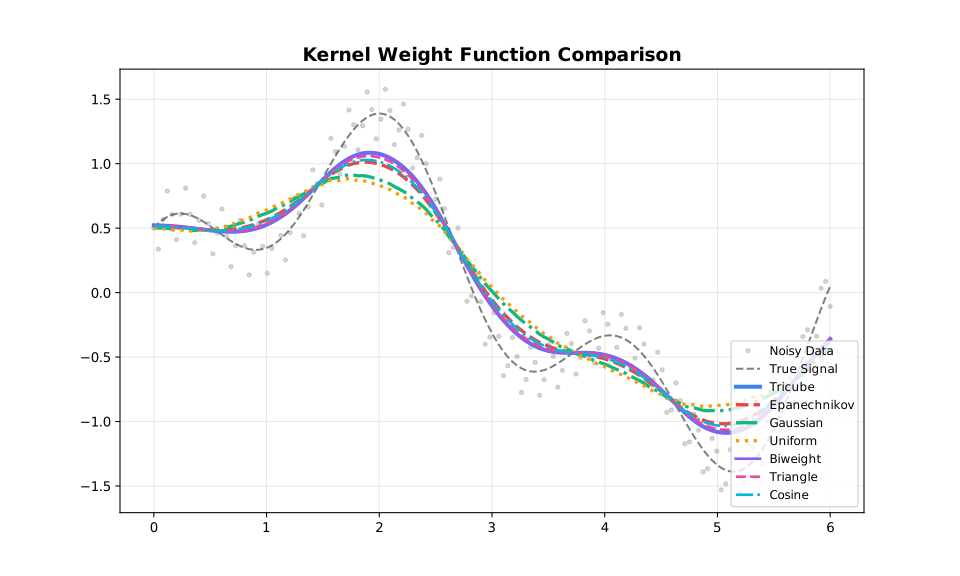
Available Kernels#
| Kernel | Efficiency | Smoothness | Support |
|---|---|---|---|
| Tricube | 0.998 | Very smooth | Compact |
| Epanechnikov | 1.000 | Smooth | Compact |
| Gaussian | 0.961 | Infinite | Unbounded |
| Biweight | 0.995 | Very smooth | Compact |
| Cosine | 0.999 | Smooth | Compact |
| Triangle | 0.989 | Moderate | Compact |
| Uniform | 0.943 | None | Compact |
Efficiency = AMISE relative to Epanechnikov (1.0 = optimal)
All examples below use the same 100-point noisy sine wave (x[i] = i * 2 * Math.PI / (n - 1); y[i] = Math.sin(x[i]) + 0.1, n = 100).
Tricube (Default)#
Cleveland’s original choice. Best all-around performance.
$$w(u) = (1 - |u|^3)^3$$Use when: Default choice for most applications.
import fastlowess.Lowess;
import fastlowess.Options;
import fastlowess.Result;

public class Example {
    public static void main(String[] args) {
        int n = 100;
        double[] x = new double[n];
        double[] y = new double[n];
        for (int i = 0; i < n; i++) {
            x[i] = i * 2 * Math.PI / (n - 1);
            y[i] = Math.sin(x[i]) + 0.1;
        }

        Options options = Options.builder().weightFunction("tricube").build();

        try (Lowess model = new Lowess(options)) {
            Result result = model.fit(x, y);
            System.out.println("First smoothed value (tricube kernel): " + result.y()[0]);
        }
    }
}
First smoothed value (tricube kernel): 0.38260776436644134Epanechnikov#
Theoretically optimal for kernel density estimation.
$$w(u) = \frac{3}{4}(1 - u^2)$$Use when: Optimal MSE properties desired.
import fastlowess.Lowess;
import fastlowess.Options;
import fastlowess.Result;

public class Example {
    public static void main(String[] args) {
        int n = 100;
        double[] x = new double[n];
        double[] y = new double[n];
        for (int i = 0; i < n; i++) {
            x[i] = i * 2 * Math.PI / (n - 1);
            y[i] = Math.sin(x[i]) + 0.1;
        }

        Options options = Options.builder().weightFunction("epanechnikov").build();

        try (Lowess model = new Lowess(options)) {
            Result result = model.fit(x, y);
            System.out.println("First smoothed value (epanechnikov kernel): " + result.y()[0]);
        }
    }
}
First smoothed value (epanechnikov kernel): 0.40672777844316566Gaussian#
Infinitely smooth. No boundary effects.
$$w(u) = \exp(-u^2/2)$$Use when: Maximum smoothness needed, computational cost acceptable.
import fastlowess.Lowess;
import fastlowess.Options;
import fastlowess.Result;

public class Example {
    public static void main(String[] args) {
        int n = 100;
        double[] x = new double[n];
        double[] y = new double[n];
        for (int i = 0; i < n; i++) {
            x[i] = i * 2 * Math.PI / (n - 1);
            y[i] = Math.sin(x[i]) + 0.1;
        }

        Options options = Options.builder().weightFunction("gaussian").build();

        try (Lowess model = new Lowess(options)) {
            Result result = model.fit(x, y);
            System.out.println("First smoothed value (gaussian kernel): " + result.y()[0]);
        }
    }
}
First smoothed value (gaussian kernel): 0.435767018911707Biweight#
Good balance of efficiency and smoothness.
$$w(u) = (1 - u^2)^2$$Use when: Alternative to Tricube with slightly different properties.
import fastlowess.Lowess;
import fastlowess.Options;
import fastlowess.Result;

public class Example {
    public static void main(String[] args) {
        int n = 100;
        double[] x = new double[n];
        double[] y = new double[n];
        for (int i = 0; i < n; i++) {
            x[i] = i * 2 * Math.PI / (n - 1);
            y[i] = Math.sin(x[i]) + 0.1;
        }

        Options options = Options.builder().weightFunction("biweight").build();

        try (Lowess model = new Lowess(options)) {
            Result result = model.fit(x, y);
            System.out.println("First smoothed value (biweight kernel): " + result.y()[0]);
        }
    }
}
First smoothed value (biweight kernel): 0.3759030457029011Uniform#
Equal weight within the window; no distance decay.
$$w(u) = 1$$Use when: You want a simple moving-average-like behavior within the neighborhood.
import fastlowess.Lowess;
import fastlowess.Options;
import fastlowess.Result;

public class Example {
    public static void main(String[] args) {
        int n = 100;
        double[] x = new double[n];
        double[] y = new double[n];
        for (int i = 0; i < n; i++) {
            x[i] = i * 2 * Math.PI / (n - 1);
            y[i] = Math.sin(x[i]) + 0.1;
        }

        Options options = Options.builder().weightFunction("uniform").build();

        try (Lowess model = new Lowess(options)) {
            Result result = model.fit(x, y);
            System.out.println("First smoothed value (uniform kernel): " + result.y()[0]);
        }
    }
}
First smoothed value (uniform kernel): 0.45083991221911446Triangle#
Linear decay to zero at the neighborhood edge.
$$w(u) = 1 - |u|$$Use when: A simple, cheap-to-evaluate kernel with compact support is preferred.
import fastlowess.Lowess;
import fastlowess.Options;
import fastlowess.Result;

public class Example {
    public static void main(String[] args) {
        int n = 100;
        double[] x = new double[n];
        double[] y = new double[n];
        for (int i = 0; i < n; i++) {
            x[i] = i * 2 * Math.PI / (n - 1);
            y[i] = Math.sin(x[i]) + 0.1;
        }

        Options options = Options.builder().weightFunction("triangle").build();

        try (Lowess model = new Lowess(options)) {
            Result result = model.fit(x, y);
            System.out.println("First smoothed value (triangle kernel): " + result.y()[0]);
        }
    }
}
First smoothed value (triangle kernel): 0.3816572331939023Cosine#
Smooth compact-support kernel, close in efficiency to Tricube.
$$w(u) = \cos\!\left(\frac{\pi u}{2}\right)$$Use when: An alternative smooth kernel to Tricube is desired.
import fastlowess.Lowess;
import fastlowess.Options;
import fastlowess.Result;

public class Example {
    public static void main(String[] args) {
        int n = 100;
        double[] x = new double[n];
        double[] y = new double[n];
        for (int i = 0; i < n; i++) {
            x[i] = i * 2 * Math.PI / (n - 1);
            y[i] = Math.sin(x[i]) + 0.1;
        }

        Options options = Options.builder().weightFunction("cosine").build();

        try (Lowess model = new Lowess(options)) {
            Result result = model.fit(x, y);
            System.out.println("First smoothed value (cosine kernel): " + result.y()[0]);
        }
    }
}
First smoothed value (cosine kernel): 0.4008299554019581Choosing a Kernel#
| Situation | Recommended Kernel |
|---|---|
| General purpose | tricube (default) |
| Theoretical MSE optimality | epanechnikov |
| Maximum smoothness, no boundary artifacts | gaussian |
| Simple, cheap alternative | uniform, triangle |