Automated parameter selection via cross-validation.
Overview#
Cross-validation helps select optimal parameters (especially fraction) by evaluating performance on held-out data.
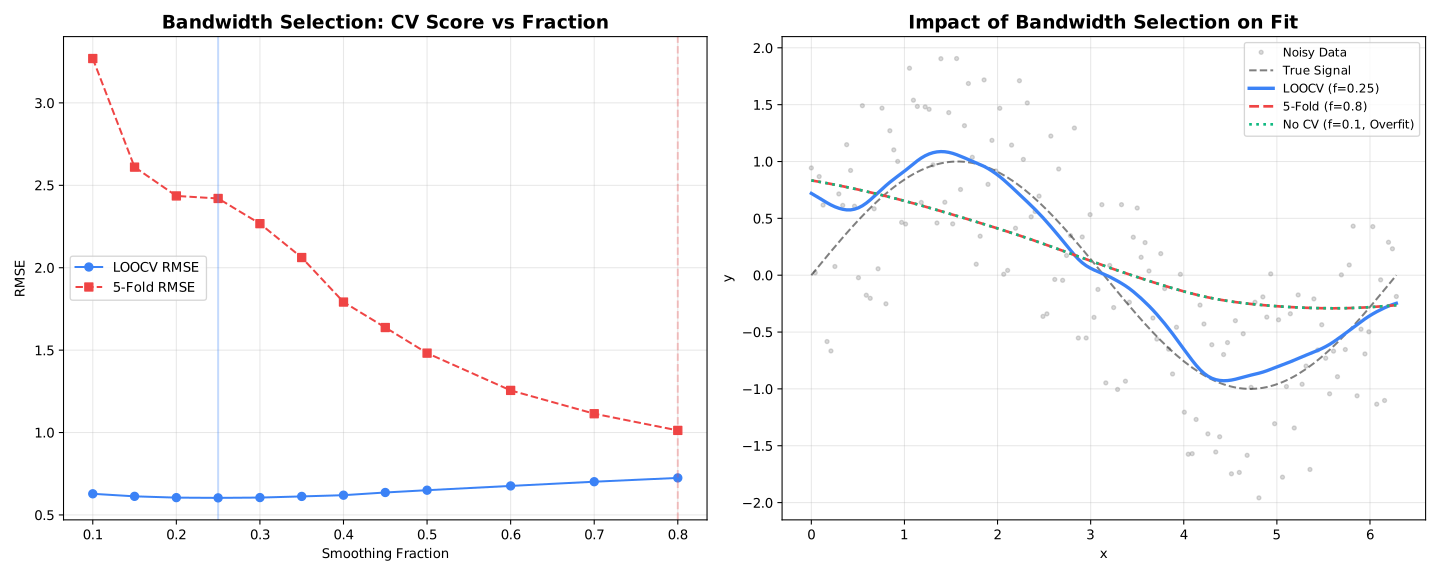
K-Fold Cross-Validation#
Split data into K folds, train on K-1, validate on 1.
import fastlowess.Lowess;
import fastlowess.Options;
import fastlowess.Result;

public class Example {
    public static void main(String[] args) {
        int n = 100;
        double[] x = new double[n];
        double[] y = new double[n];
        for (int i = 0; i < n; i++) {
            x[i] = i * 2 * Math.PI / (n - 1);
            y[i] = Math.sin(x[i]) + 0.1;
        }

        Options options = Options.builder()
                .cvMethod("kfold")
                .cvK(5)
                .cvFractions(new double[] { 0.2, 0.3, 0.5, 0.7 })
                .build();

        try (Lowess model = new Lowess(options)) {
            Result result = model.fit(x, y);

            // The best fraction was automatically selected
            System.out.println("Selected fraction: " + result.fractionUsed());
            System.out.println("CV scores: " + java.util.Arrays.toString(result.cvScores().orElseThrow()));
        }
    }
}
Selected fraction: 0.2
CV scores: [0.2660065925434151, 0.26663733476135043, 0.36243048571062464, 0.4466813477111353]Leave-One-Out (LOOCV)#
Each point is held out once. Most thorough but slowest.
import fastlowess.Lowess;
import fastlowess.Options;
import fastlowess.Result;

public class Example {
    public static void main(String[] args) {
        int n = 100;
        double[] x = new double[n];
        double[] y = new double[n];
        for (int i = 0; i < n; i++) {
            x[i] = i * 2 * Math.PI / (n - 1);
            y[i] = Math.sin(x[i]) + 0.1;
        }

        Options options = Options.builder()
                .cvMethod("loocv")
                .cvFractions(new double[] { 0.2, 0.3, 0.5, 0.7 })
                .build();

        try (Lowess model = new Lowess(options)) {
            Result result = model.fit(x, y);
            System.out.println("Selected fraction (CV): " + result.fractionUsed());
        }
    }
}
Selected fraction (CV): 0.2Seeded Randomization#
Set a seed for reproducible fold assignments:
import fastlowess.Lowess;
import fastlowess.Options;
import fastlowess.Result;

public class Example {
    public static void main(String[] args) {
        int n = 100;
        double[] x = new double[n];
        double[] y = new double[n];
        for (int i = 0; i < n; i++) {
            x[i] = i * 2 * Math.PI / (n - 1);
            y[i] = Math.sin(x[i]) + 0.1;
        }

        Options options = Options.builder()
                .cvMethod("kfold")
                .cvK(5)
                .cvFractions(new double[] { 0.3, 0.5, 0.7 })
                .cvSeed(42L)
                .build();

        try (Lowess model = new Lowess(options)) {
            Result result = model.fit(x, y);
            System.out.println("Selected fraction (CV): " + result.fractionUsed());
        }
    }
}
Selected fraction (CV): 0.7Comparison#
| Method | Folds | Speed | Variance | Bias |
|---|---|---|---|---|
| KFold(5) | 5 | Fast | Moderate | Low |
| KFold(10) | 10 | Medium | Lower | Lower |
| LOOCV | N | Slow | Lowest | Lowest |
Recommendation: Use 5-fold or 10-fold CV for most applications. LOOCV is only worth it for small datasets (N < 100).
CV Metrics#
Cross-validation uses MSE (Mean Squared Error) by default:
MSE = mean((y_true - y_pred)²)Lower MSE indicates better fit on held-out data.
Interpreting Results#
import fastlowess.Lowess;
import fastlowess.Options;
import fastlowess.Result;

public class Example {
    public static void main(String[] args) {
        int n = 100;
        double[] x = new double[n];
        double[] y = new double[n];
        for (int i = 0; i < n; i++) {
            x[i] = i * 2 * Math.PI / (n - 1);
            y[i] = Math.sin(x[i]) + 0.1;
        }

        Options options = Options.builder()
                .cvMethod("kfold")
                .cvK(5)
                .cvFractions(new double[] { 0.1, 0.3, 0.5, 0.7 })
                .build();

        // Fraction  | CV Score (MSE)
        // 0.1       | 0.0542  <- Undersmoothed
        // 0.3       | 0.0231  <- Best
        // 0.5       | 0.0298
        // 0.7       | 0.0412  <- Oversmoothed

        try (Lowess model = new Lowess(options)) {
            Result result = model.fit(x, y);
            System.out.println("Selected fraction (CV): " + result.fractionUsed());
        }
    }
}
Selected fraction (CV): 0.3The fraction with lowest CV score is automatically selected.
Availability#
Batch Mode Only: Cross-validation is only available in Batch mode.
| Feature | Batch | Streaming | Online |
|---|---|---|---|
| K-Fold CV | ✓ | ✗ | ✗ |
| LOOCV | ✓ | ✗ | ✗ |
Best Practices#
- Test a range: Include fractions from 0.1 to 0.9
- Use enough folds: 5-10 folds balance speed and accuracy
- Set a seed: For reproducible results
- Check the curve: CV optimizes MSE, but visual inspection matters