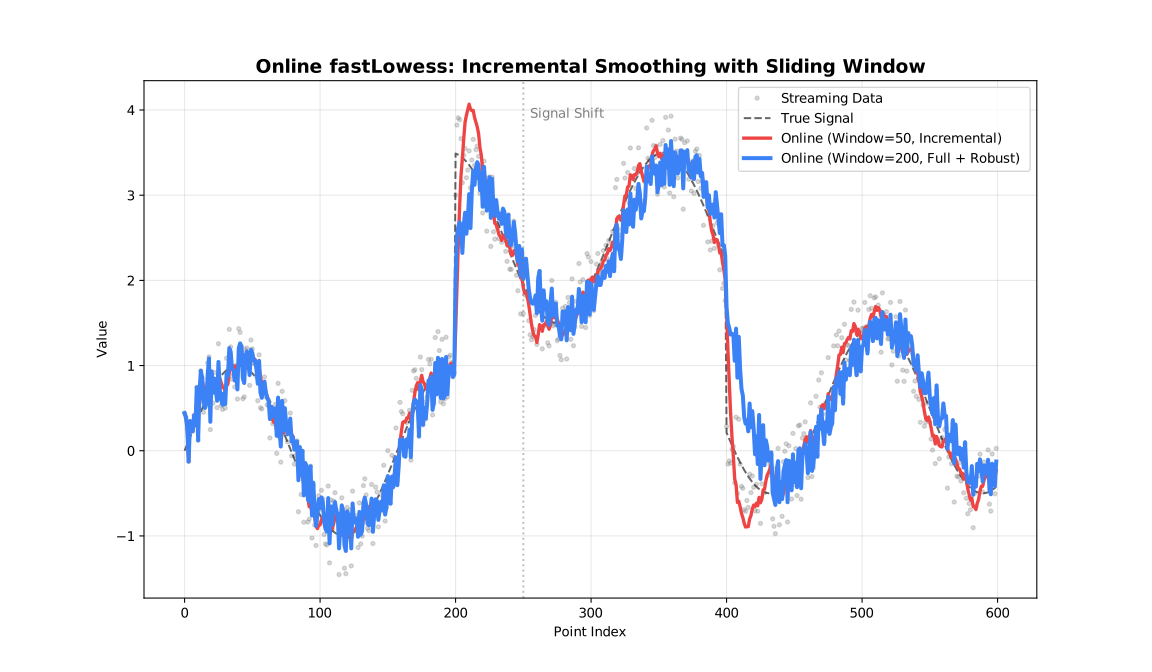
For real-time data: processes one (x, y) point at a time and returns a smoothed value immediately once enough points have been seen.
See also: API
OnlineOptions.builder() OnlineOptions.Builder#
OnlineOptions options = OnlineOptions.builder()
        .windowCapacity(200)
        .minPoints(10)
        .build();
OnlineOptions.Builder exposes all the same settings as Options.Builder (except returnSe, cvFractions/cvMethod/cvK/cvSeed, and backend, which are batch-only). Note parallel still defaults to true in the builder, but per-point updates rarely benefit from parallelism in practice. Additional settings:
| Setting | Type | Default | Description |
|---|---|---|---|
windowCapacity | int | 100 | Maximum number of recent points retained. |
minPoints | int | 10 | Minimum points required before output starts. |
updateMode | String | "full" | How the window is updated as new points arrive: incremental, full. |
new OnlineLowess(OnlineOptions options)#
OnlineLowess.addPoint(double x, double y) Optional<PointResult>#
Adds a single observation. Returns Optional.empty() while the window is still filling (fewer than minPoints seen so far); once populated, the PointResult holds the smoothed value for the most recently added point.
OnlineLowess.close()#
Releases native resources. Safe to call multiple times. Implements AutoCloseable.
PointResult accessors#
| Accessor | Type | Notes |
|---|---|---|
y() | double | Smoothed value. |
standardError() | OptionalDouble | Empty if not computed. |
residual() | OptionalDouble | Empty if not computed. |
robustnessWeight() | OptionalDouble | Empty if not computed. |
iterationsUsed() | OptionalInt | Empty if not applicable. |
Example#
import fastlowess.OnlineLowess;
import fastlowess.OnlineOptions;
import fastlowess.PointResult;

import java.util.Optional;

OnlineOptions options = OnlineOptions.builder().build();

try (OnlineLowess model = new OnlineLowess(options)) {
    for (Point point : sensorReadings) {
        Optional<PointResult> res = model.addPoint(point.x(), point.y());
        res.ifPresent(r -> System.out.println("smoothed: " + r.y()));
    }
}