Outlier handling through iterative reweighting.
How Robustness Works
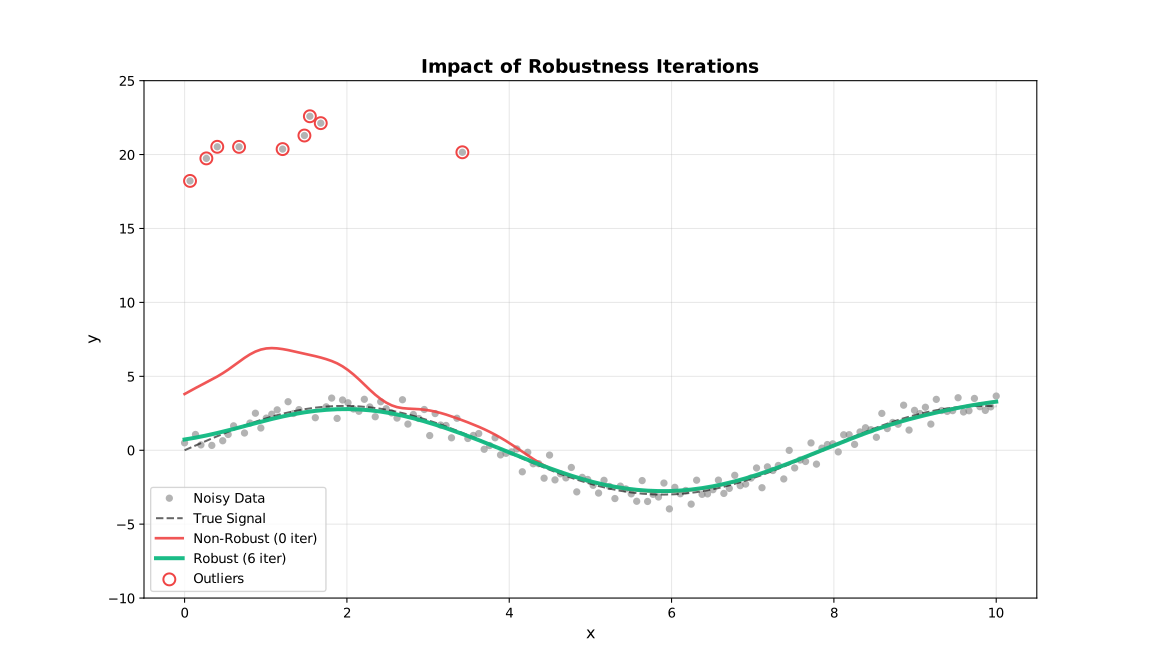
Standard LOWESS can be biased by outliers. Robustness iterations downweight points with large residuals:
- Fit initial LOWESS
- Compute residuals
- Assign robustness weights (large residuals → low weight)
- Refit using combined distance × robustness weights
- Repeat steps 2–4
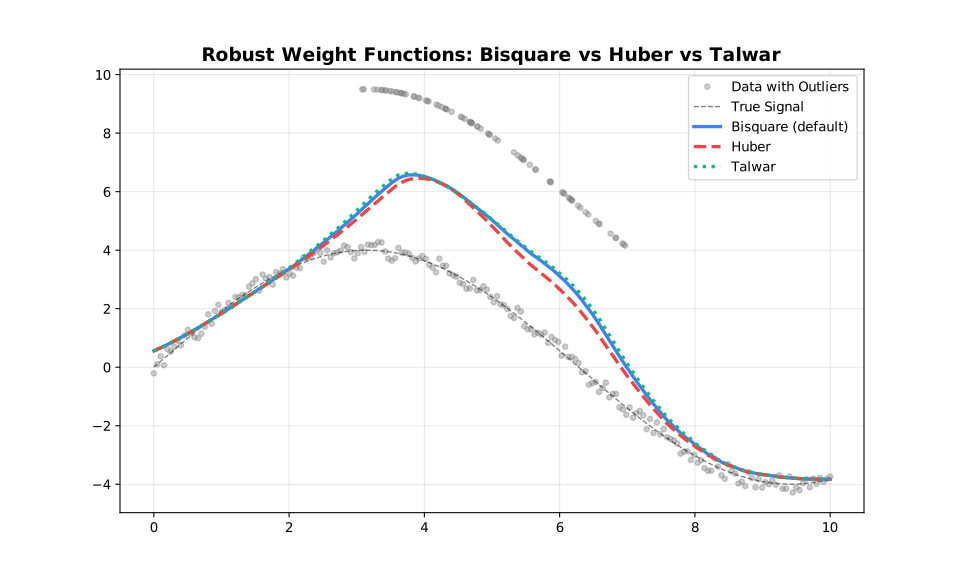
Robustness Methods
Bisquare (Default)
Smooth downweighting. Points transition gradually from full weight to zero.
$$w(u) = \begin{cases} (1 - u^2)^2 & |u| < 1 \\ 0 & |u| \geq 1 \end{cases}$$Use when: General purpose, balanced approach.
package main

import (
 "fmt"
 "log"
 "math"

 "github.com/thisisamirv/lowess-project/bindings/go/fastlowess/v5"
)

func main() {
 n := 100
 x := make([]float64, n)
 y := make([]float64, n)
 for i := 0; i < n; i++ {
  x[i] = float64(i) * 2 * math.Pi / float64(n-1)
  y[i] = math.Sin(x[i]) + 0.1
 }

 opts := fastlowess.DefaultOptions()
 opts.Iterations = 3
 opts.RobustnessMethod = "bisquare"
 model, err := fastlowess.NewLowess(opts)
 if err != nil {
  log.Fatal(err)
 }
 defer model.Close()

 result, err := model.Fit(x, y)
 if err != nil {
  log.Fatal(err)
 }
 fmt.Println("First smoothed value (bisquare robustness):", result.Y[0])
}
First smoothed value (bisquare robustness): 0.38088390025381585Huber
Linear penalty beyond threshold. Less aggressive than Bisquare.
$$w(u) = \begin{cases} 1 & |u| \leq k \\ k/|u| & |u| > k \end{cases}$$Use when: Moderate outliers, want to retain some influence.
package main

import (
 "fmt"
 "log"
 "math"

 "github.com/thisisamirv/lowess-project/bindings/go/fastlowess/v5"
)

func main() {
 n := 100
 x := make([]float64, n)
 y := make([]float64, n)
 for i := 0; i < n; i++ {
  x[i] = float64(i) * 2 * math.Pi / float64(n-1)
  y[i] = math.Sin(x[i]) + 0.1
 }

 opts := fastlowess.DefaultOptions()
 opts.Iterations = 3
 opts.RobustnessMethod = "huber"
 model, err := fastlowess.NewLowess(opts)
 if err != nil {
  log.Fatal(err)
 }
 defer model.Close()

 result, err := model.Fit(x, y)
 if err != nil {
  log.Fatal(err)
 }
 fmt.Println("First smoothed value (huber robustness):", result.Y[0])
}
First smoothed value (huber robustness): 0.3789215614787961Talwar
Hard threshold. Points are either fully weighted or completely excluded.
$$w(u) = \begin{cases} 1 & |u| \leq k \\ 0 & |u| > k \end{cases}$$Use when: Extreme outliers, want binary exclusion.
package main

import (
 "fmt"
 "log"
 "math"

 "github.com/thisisamirv/lowess-project/bindings/go/fastlowess/v5"
)

func main() {
 n := 100
 x := make([]float64, n)
 y := make([]float64, n)
 for i := 0; i < n; i++ {
  x[i] = float64(i) * 2 * math.Pi / float64(n-1)
  y[i] = math.Sin(x[i]) + 0.1
 }

 opts := fastlowess.DefaultOptions()
 opts.Iterations = 3
 opts.RobustnessMethod = "talwar"
 model, err := fastlowess.NewLowess(opts)
 if err != nil {
  log.Fatal(err)
 }
 defer model.Close()

 result, err := model.Fit(x, y)
 if err != nil {
  log.Fatal(err)
 }
 fmt.Println("First smoothed value (talwar robustness):", result.Y[0])
}
First smoothed value (talwar robustness): 0.3787793754241902Comparison
| Method | Transition | Aggressiveness | Use Case |
|---|---|---|---|
| Bisquare | Smooth | Moderate | General purpose |
| Huber | Gradual | Mild | Preserve influence |
| Talwar | Hard | Strong | Extreme contamination |
Detecting Outliers
Use robustness weights to identify potential outliers:
package main

import (
 "fmt"
 "log"
 "math"

 "github.com/thisisamirv/lowess-project/bindings/go/fastlowess/v5"
)

func main() {
 n := 100
 x := make([]float64, n)
 y := make([]float64, n)
 for i := 0; i < n; i++ {
  x[i] = float64(i) * 2 * math.Pi / float64(n-1)
  y[i] = math.Sin(x[i]) + 0.1
 }
 for _, i := range []int{20, 50, 80} {
  y[i] += 5.0 // inject outliers
 }

 opts := fastlowess.DefaultOptions()
 opts.Iterations = 5
 opts.Outputs = []string{"weights"}
 model, err := fastlowess.NewLowess(opts)
 if err != nil {
  log.Fatal(err)
 }
 defer model.Close()

 result, err := model.Fit(x, y)
 if err != nil {
  log.Fatal(err)
 }

 count := 0
 for i, w := range result.RobustnessWeights {
  if w < 0.5 {
   if count < 5 {
    fmt.Printf("Potential outlier at index %d: weight = %.3f\n", i, w)
   }
   count++
  }
 }
}
Potential outlier at index 20: weight = 0.000
Potential outlier at index 50: weight = 0.000
Potential outlier at index 80: weight = 0.000Scale Estimation
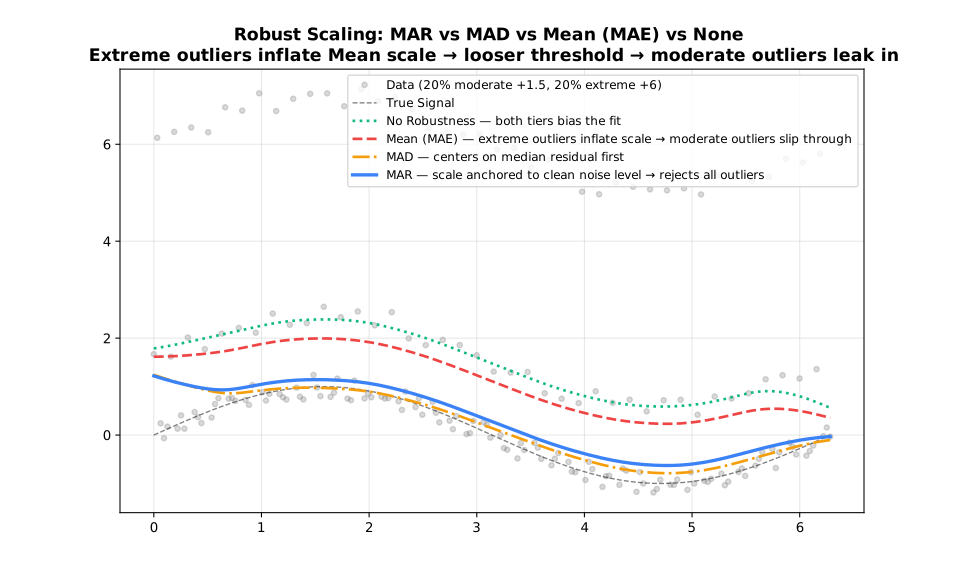
Residuals are scaled before computing robustness weights. Two methods:
| Method | Formula | Robustness |
|---|---|---|
| MAD | median(|r − median(r)|) | Very robust (default) |
| MAR | median(|r|) | Robust, uncentered |
| Mean | mean(|r|) | Less robust, fastest |
package main

import (
 "fmt"
 "log"
 "math"

 "github.com/thisisamirv/lowess-project/bindings/go/fastlowess/v5"
)

func main() {
 n := 100
 x := make([]float64, n)
 y := make([]float64, n)
 for i := 0; i < n; i++ {
  x[i] = float64(i) * 2 * math.Pi / float64(n-1)
  y[i] = math.Sin(x[i]) + 0.1
 }

 opts := fastlowess.DefaultOptions()
 opts.Iterations = 3
 opts.ScalingMethod = "mad" // Default
 model, err := fastlowess.NewLowess(opts)
 if err != nil {
  log.Fatal(err)
 }
 defer model.Close()

 result, err := model.Fit(x, y)
 if err != nil {
  log.Fatal(err)
 }
 fmt.Println("First smoothed value (mad scaling):", result.Y[0])
}
First smoothed value (mad scaling): 0.38088390025381585See Scaling Methods for a full breakdown.
Auto-Convergence
Stop iterations early when weights stabilize:
Performance: Auto-convergence can significantly reduce computation when weights stabilize before reaching max iterations.
package main

import (
 "fmt"
 "log"
 "math"

 "github.com/thisisamirv/lowess-project/bindings/go/fastlowess/v5"
)

func main() {
 n := 100
 x := make([]float64, n)
 y := make([]float64, n)
 for i := 0; i < n; i++ {
  x[i] = float64(i) * 2 * math.Pi / float64(n-1)
  y[i] = math.Sin(x[i]) + 0.1
 }

 opts := fastlowess.DefaultOptions()
 opts.Iterations = 10 // Maximum iterations
 converge := 1e-6      // Stop when change < 1e-6
 opts.AutoConverge = &converge
 model, err := fastlowess.NewLowess(opts)
 if err != nil {
  log.Fatal(err)
 }
 defer model.Close()

 result, err := model.Fit(x, y)
 if err != nil {
  log.Fatal(err)
 }
 fmt.Println("First smoothed value (auto-converge):", result.Y[0])
}
First smoothed value (auto-converge): 0.3808832251069814