Kernel functions for distance weighting.
Overview
Weight functions (kernels) determine how neighboring points contribute to each local fit. Points closer to the target receive higher weights.
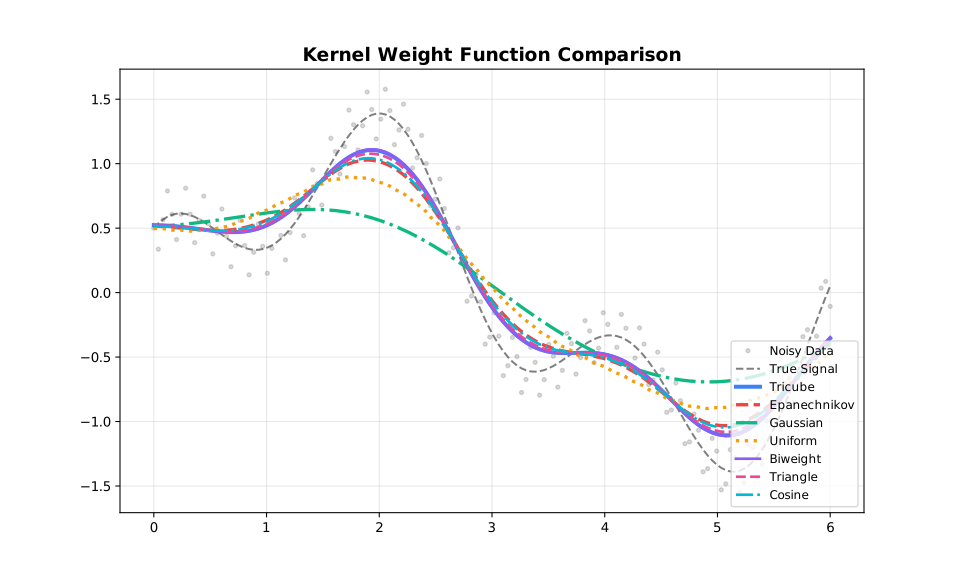
Available Kernels
| Kernel | Efficiency | Smoothness | Support |
|---|---|---|---|
| Tricube | 0.998 | Very smooth | Compact |
| Epanechnikov | 1.000 | Smooth | Compact |
| Gaussian | 0.961 | Infinite | Unbounded |
| Biweight | 0.995 | Very smooth | Compact |
| Cosine | 0.999 | Smooth | Compact |
| Triangle | 0.989 | Moderate | Compact |
| Uniform | 0.943 | None | Compact |
Efficiency = AMISE relative to Epanechnikov (1.0 = optimal)
Tricube (Default)
Cleveland’s original choice. Best all-around performance.
$$w(u) = (1 - |u|^3)^3$$Use when: Default choice for most applications.
package main

import (
 "fmt"
 "log"
 "math"

 "github.com/thisisamirv/lowess-project/bindings/go/fastlowess/v5"
)

func main() {
 n := 100
 x := make([]float64, n)
 y := make([]float64, n)
 for i := 0; i < n; i++ {
  x[i] = float64(i) * 2 * math.Pi / float64(n-1)
  y[i] = math.Sin(x[i]) + 0.1
 }

 opts := fastlowess.DefaultOptions()
 opts.WeightFunction = "tricube"
 model, err := fastlowess.NewLowess(opts)
 if err != nil {
  log.Fatal(err)
 }
 defer model.Close()

 result, err := model.Fit(x, y)
 if err != nil {
  log.Fatal(err)
 }
 fmt.Println("First smoothed value (tricube kernel):", result.Y[0])
}
First smoothed value (tricube kernel): 0.38088390025381585Epanechnikov
Theoretically optimal for kernel density estimation.
$$w(u) = \frac{3}{4}(1 - u^2)$$Use when: Optimal MSE properties desired.
package main

import (
 "fmt"
 "log"
 "math"

 "github.com/thisisamirv/lowess-project/bindings/go/fastlowess/v5"
)

func main() {
 n := 100
 x := make([]float64, n)
 y := make([]float64, n)
 for i := 0; i < n; i++ {
  x[i] = float64(i) * 2 * math.Pi / float64(n-1)
  y[i] = math.Sin(x[i]) + 0.1
 }

 opts := fastlowess.DefaultOptions()
 opts.WeightFunction = "epanechnikov"
 model, err := fastlowess.NewLowess(opts)
 if err != nil {
  log.Fatal(err)
 }
 defer model.Close()

 result, err := model.Fit(x, y)
 if err != nil {
  log.Fatal(err)
 }
 fmt.Println("First smoothed value (epanechnikov kernel):", result.Y[0])
}
First smoothed value (epanechnikov kernel): 0.406923278722846Gaussian
Infinitely smooth. No boundary effects.
$$w(u) = \exp(-u^2/2)$$Use when: Maximum smoothness needed, computational cost acceptable.
package main

import (
 "fmt"
 "log"
 "math"

 "github.com/thisisamirv/lowess-project/bindings/go/fastlowess/v5"
)

func main() {
 n := 100
 x := make([]float64, n)
 y := make([]float64, n)
 for i := 0; i < n; i++ {
  x[i] = float64(i) * 2 * math.Pi / float64(n-1)
  y[i] = math.Sin(x[i]) + 0.1
 }

 opts := fastlowess.DefaultOptions()
 opts.WeightFunction = "gaussian"
 model, err := fastlowess.NewLowess(opts)
 if err != nil {
  log.Fatal(err)
 }
 defer model.Close()

 result, err := model.Fit(x, y)
 if err != nil {
  log.Fatal(err)
 }
 fmt.Println("First smoothed value (gaussian kernel):", result.Y[0])
}
First smoothed value (gaussian kernel): 0.35401405464559677Biweight
Good balance of efficiency and smoothness.
$$w(u) = (1 - u^2)^2$$Use when: Alternative to Tricube with slightly different properties.
package main

import (
 "fmt"
 "log"
 "math"

 "github.com/thisisamirv/lowess-project/bindings/go/fastlowess/v5"
)

func main() {
 n := 100
 x := make([]float64, n)
 y := make([]float64, n)
 for i := 0; i < n; i++ {
  x[i] = float64(i) * 2 * math.Pi / float64(n-1)
  y[i] = math.Sin(x[i]) + 0.1
 }

 opts := fastlowess.DefaultOptions()
 opts.WeightFunction = "biweight"
 model, err := fastlowess.NewLowess(opts)
 if err != nil {
  log.Fatal(err)
 }
 defer model.Close()

 result, err := model.Fit(x, y)
 if err != nil {
  log.Fatal(err)
 }
 fmt.Println("First smoothed value (biweight kernel):", result.Y[0])
}
First smoothed value (biweight kernel): 0.3743954563102442Cosine
Smooth and computationally efficient.
$$w(u) = \cos(\pi u / 2)$$Use when: Want smooth kernel with simple form.
package main

import (
 "fmt"
 "log"
 "math"

 "github.com/thisisamirv/lowess-project/bindings/go/fastlowess/v5"
)

func main() {
 n := 100
 x := make([]float64, n)
 y := make([]float64, n)
 for i := 0; i < n; i++ {
  x[i] = float64(i) * 2 * math.Pi / float64(n-1)
  y[i] = math.Sin(x[i]) + 0.1
 }

 opts := fastlowess.DefaultOptions()
 opts.WeightFunction = "cosine"
 model, err := fastlowess.NewLowess(opts)
 if err != nil {
  log.Fatal(err)
 }
 defer model.Close()

 result, err := model.Fit(x, y)
 if err != nil {
  log.Fatal(err)
 }
 fmt.Println("First smoothed value (cosine kernel):", result.Y[0])
}
First smoothed value (cosine kernel): 0.4007691120197535Triangle
Simple linear taper.
$$w(u) = 1 - |u|$$Use when: Simple, interpretable weights.
package main

import (
 "fmt"
 "log"
 "math"

 "github.com/thisisamirv/lowess-project/bindings/go/fastlowess/v5"
)

func main() {
 n := 100
 x := make([]float64, n)
 y := make([]float64, n)
 for i := 0; i < n; i++ {
  x[i] = float64(i) * 2 * math.Pi / float64(n-1)
  y[i] = math.Sin(x[i]) + 0.1
 }

 opts := fastlowess.DefaultOptions()
 opts.WeightFunction = "triangle"
 model, err := fastlowess.NewLowess(opts)
 if err != nil {
  log.Fatal(err)
 }
 defer model.Close()

 result, err := model.Fit(x, y)
 if err != nil {
  log.Fatal(err)
 }
 fmt.Println("First smoothed value (triangle kernel):", result.Y[0])
}
First smoothed value (triangle kernel): 0.38102907107175976Uniform
Equal weights within window. Fastest but least smooth.
$$w(u) = 1$$Use when: Speed is critical, smoothness less important.
package main

import (
 "fmt"
 "log"
 "math"

 "github.com/thisisamirv/lowess-project/bindings/go/fastlowess/v5"
)

func main() {
 n := 100
 x := make([]float64, n)
 y := make([]float64, n)
 for i := 0; i < n; i++ {
  x[i] = float64(i) * 2 * math.Pi / float64(n-1)
  y[i] = math.Sin(x[i]) + 0.1
 }

 opts := fastlowess.DefaultOptions()
 opts.WeightFunction = "uniform"
 model, err := fastlowess.NewLowess(opts)
 if err != nil {
  log.Fatal(err)
 }
 defer model.Close()

 result, err := model.Fit(x, y)
 if err != nil {
  log.Fatal(err)
 }
 fmt.Println("First smoothed value (uniform kernel):", result.Y[0])
}
First smoothed value (uniform kernel): 0.45455195196938875Choosing a Kernel
Choose the first row below whose condition applies:
| Condition | Kernel |
|---|---|
| Need maximum smoothness | "gaussian" |
| Default is acceptable | "tricube" |
| Need optimal asymptotic MSE | "epanechnikov" |
| Speed is critical | "uniform" |
| None of the above | "biweight" |
Recommendation: Stick with Tricube (default) unless you have specific requirements. The differences between kernels are usually small in practice.