Automated parameter selection via cross-validation.
Overview
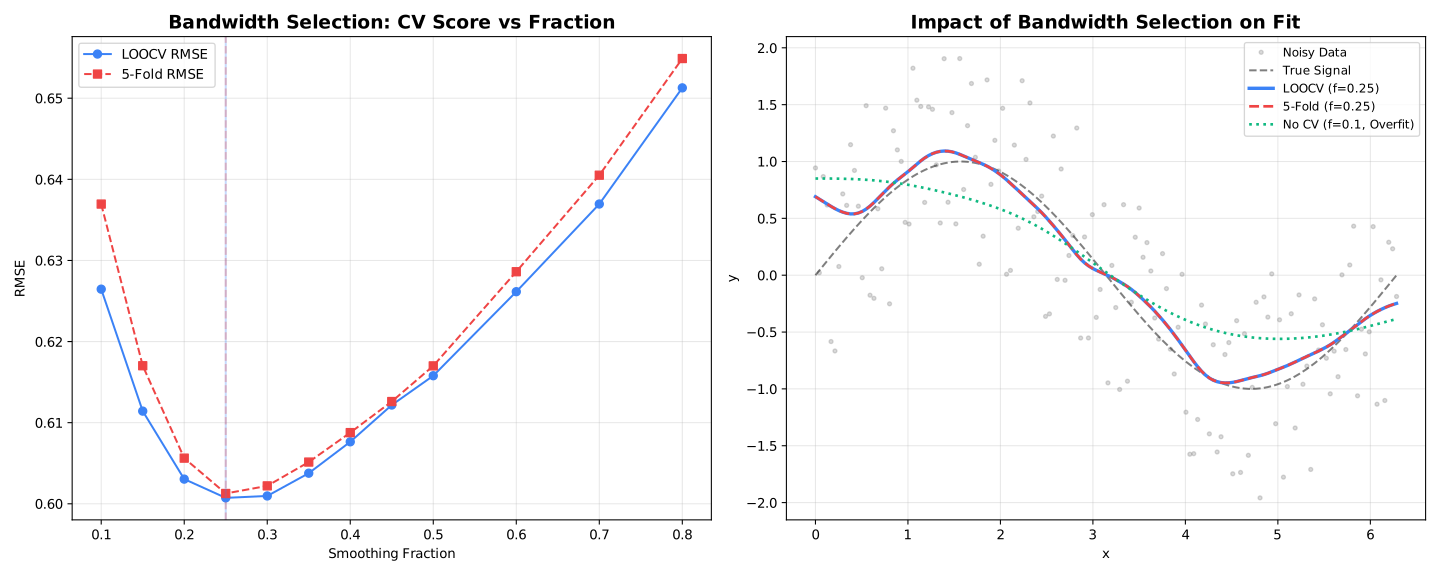
Cross-validation helps select optimal parameters (especially Fraction) by evaluating performance on held-out data.
K-Fold Cross-Validation
Split data into K folds, train on K-1, validate on 1.
package main

import (
 "fmt"
 "log"
 "math"

 "github.com/thisisamirv/lowess-project/bindings/go/fastlowess/v5"
)

func main() {
 n := 100
 x := make([]float64, n)
 y := make([]float64, n)
 for i := 0; i < n; i++ {
  x[i] = float64(i) * 2 * math.Pi / float64(n-1)
  y[i] = math.Sin(x[i]) + 0.1
 }

 opts := fastlowess.DefaultOptions()
 opts.CV = &fastlowess.CVOptions{Method: "kfold", K: 5, Fractions: []float64{0.2, 0.3, 0.5, 0.7}}

 model, err := fastlowess.NewLowess(opts)
 if err != nil {
  log.Fatal(err)
 }
 defer model.Close()

 result, err := model.Fit(x, y)
 if err != nil {
  log.Fatal(err)
 }

 // The best fraction was automatically selected
 fmt.Println("Selected fraction:", result.FractionUsed)
 fmt.Println("CV scores:", result.CVScores)
}
Selected fraction: 0.3
CV scores: [0.34420283951471764 0.3436434119247782 0.3998652340225231 0.4760102176301601]Leave-One-Out (LOOCV)
Each point is held out once. Most thorough but slowest.
package main

import (
 "fmt"
 "log"
 "math"

 "github.com/thisisamirv/lowess-project/bindings/go/fastlowess/v5"
)

func main() {
 n := 100
 x := make([]float64, n)
 y := make([]float64, n)
 for i := 0; i < n; i++ {
  x[i] = float64(i) * 2 * math.Pi / float64(n-1)
  y[i] = math.Sin(x[i]) + 0.1
 }

 opts := fastlowess.DefaultOptions()
 opts.CV = &fastlowess.CVOptions{Method: "loocv", Fractions: []float64{0.2, 0.3, 0.5, 0.7}}

 model, err := fastlowess.NewLowess(opts)
 if err != nil {
  log.Fatal(err)
 }
 defer model.Close()

 result, err := model.Fit(x, y)
 if err != nil {
  log.Fatal(err)
 }
 fmt.Println("Selected fraction (CV):", result.FractionUsed)
}
Selected fraction (CV): 0.2Seeded Randomization
Set a seed for reproducible fold assignments:
package main

import (
 "fmt"
 "log"
 "math"

 "github.com/thisisamirv/lowess-project/bindings/go/fastlowess/v5"
)

func main() {
 n := 100
 x := make([]float64, n)
 y := make([]float64, n)
 for i := 0; i < n; i++ {
  x[i] = float64(i) * 2 * math.Pi / float64(n-1)
  y[i] = math.Sin(x[i]) + 0.1
 }

 opts := fastlowess.DefaultOptions()
 opts.CV = &fastlowess.CVOptions{Method: "kfold", K: 5, Fractions: []float64{0.3, 0.5, 0.7}}
 seed := uint64(42)
 opts.Seed = &seed

 model, err := fastlowess.NewLowess(opts)
 if err != nil {
  log.Fatal(err)
 }
 defer model.Close()

 result, err := model.Fit(x, y)
 if err != nil {
  log.Fatal(err)
 }
 fmt.Println("Selected fraction (CV):", result.FractionUsed)
}
Selected fraction (CV): 0.3Comparison
| Method | Folds | Speed | Variance | Bias |
|---|---|---|---|---|
| KFold(5) | 5 | Fast | Moderate | Low |
| KFold(10) | 10 | Medium | Lower | Lower |
| LOOCV | N | Slow | Lowest | Lowest |
Recommendation: Use 5-fold or 10-fold CV for most applications. LOOCV is only worth it for small datasets (N < 100).
CV Metrics
Cross-validation uses MSE (Mean Squared Error) by default:
MSE = mean((y_true - y_pred)^2)Lower MSE indicates better fit on held-out data.
Interpreting Results
package main

import (
 "fmt"
 "log"
 "math"

 "github.com/thisisamirv/lowess-project/bindings/go/fastlowess/v5"
)

func main() {
 n := 100
 x := make([]float64, n)
 y := make([]float64, n)
 for i := 0; i < n; i++ {
  x[i] = float64(i) * 2 * math.Pi / float64(n-1)
  y[i] = math.Sin(x[i]) + 0.1
 }

 opts := fastlowess.DefaultOptions()
 opts.CV = &fastlowess.CVOptions{Method: "kfold", K: 5, Fractions: []float64{0.1, 0.3, 0.5, 0.7}}

 // Fraction  | CV Score (MSE)
 // 0.1       | 0.0542  <- Undersmoothed
 // 0.3       | 0.0231  <- Best
 // 0.5       | 0.0298
 // 0.7       | 0.0412  <- Oversmoothed

 model, err := fastlowess.NewLowess(opts)
 if err != nil {
  log.Fatal(err)
 }
 defer model.Close()

 result, err := model.Fit(x, y)
 if err != nil {
  log.Fatal(err)
 }
 fmt.Println("Selected fraction (CV):", result.FractionUsed)
}
Selected fraction (CV): 0.3The fraction with lowest CV score is automatically selected.
Availability
Batch Mode Only: Cross-validation is only available in Batch mode.
| Feature | Batch | Streaming | Online |
|---|---|---|---|
| K-Fold CV | ✓ | ✗ | ✗ |
| LOOCV | ✓ | ✗ | ✗ |
Best Practices
- Test a range: Include fractions from 0.1 to 0.9
- Use enough folds: 5-10 folds balance speed and accuracy
- Set a seed: For reproducible results
- Check the curve: CV optimizes MSE, but visual inspection matters