Overview
When iterations > 0, LOESS computes robustness
weights by comparing each residual to the current residual scale
estimate
.
The scaling_method parameter controls how
is estimated.
| Method | Formula | Robustness | Speed |
|---|---|---|---|
"mad" |
Median absolute deviation from median | Very robust | Moderate |
"mar" |
Median of |residuals| | Robust | Fast |
"mean" |
Mean of |residuals| | Less robust | Fastest |
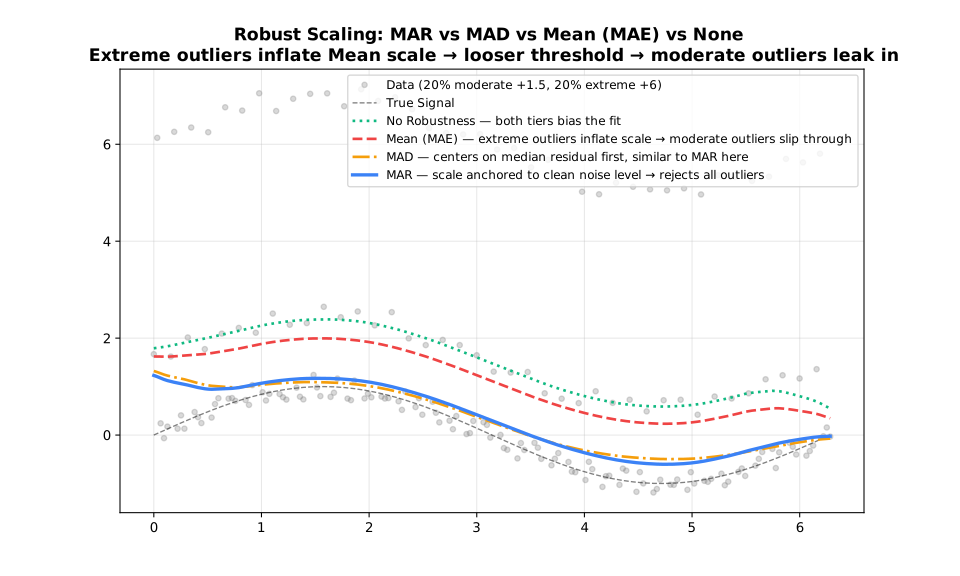
MAD — Median Absolute Deviation (Default)
First centers residuals at their median, then takes the median of the absolute deviations. Double use of the median makes it highly resistant to extreme outliers.
Use when: Data may contain outliers (default for most applications).
library(rfastloess)
set.seed(42)
x <- seq(0, 2 * pi, length.out = 100)
y <- sin(x) + rnorm(100, sd = 0.3)

model <- Loess(iterations = 3, scaling_method = "mad")
result <- fit(model, x, y)
cat("Smoothed y[0]:", result$y[1], "\n")
#> Smoothed y[0]: 0.4897657
MAR — Median Absolute Residual
Uses the uncentered median — unlike MAD it does not subtract the residual median first. Still robust (median-based), faster (one partial sort instead of two).
Use when: Speed matters and data have minimal systematic bias in residuals.
model <- Loess(iterations = 3, scaling_method = "mar")
result <- fit(model, x, y)
cat("Smoothed y[0]:", result$y[1], "\n")
#> Smoothed y[0]: 0.5096452
Mean — Mean Absolute Residual
Arithmetic mean of absolute residuals. Non-robust: a single extreme outlier inflates , causing the bisquare weight function to under-downweight other outliers.
Use when: Clean data with no outliers; maximum computation speed required.
model <- Loess(iterations = 3, scaling_method = "mean")
result <- fit(model, x, y)
cat("Smoothed y[0]:", result$y[1], "\n")
#> Smoothed y[0]: 0.512746
Choosing a Scaling Method
| Situation | Recommended Method |
|---|---|
| General purpose, possible outliers |
"mad" (default) |
| Speed matters; residuals have minimal systematic bias | "mar" |
| Clean data, no outliers | "mean" |
See vignette("robustness", package = "rfastloess") for a
broader discussion of outlier handling.
Comparing Scaling Methods
library(rfastloess)
set.seed(42)
x <- 1:100
y <- sin(x / 10) + rnorm(100, sd = 0.3)
y[c(20, 50, 80)] <- y[c(20, 50, 80)] + 5  # outliers

methods <- c("mad", "mar", "mean")
colors  <- c("blue", "red", "green")

plot(x, y, pch = 16, col = "gray",
    main = "Scaling Method Comparison (with outliers)")

for (i in seq_along(methods)) {
    model  <- Loess(iterations = 3, scaling_method = methods[i])
    result <- fit(model, x, y)
    lines(result$x, result$y, col = colors[i], lwd = 2)
}

legend("topright", methods, col = colors, lwd = 2)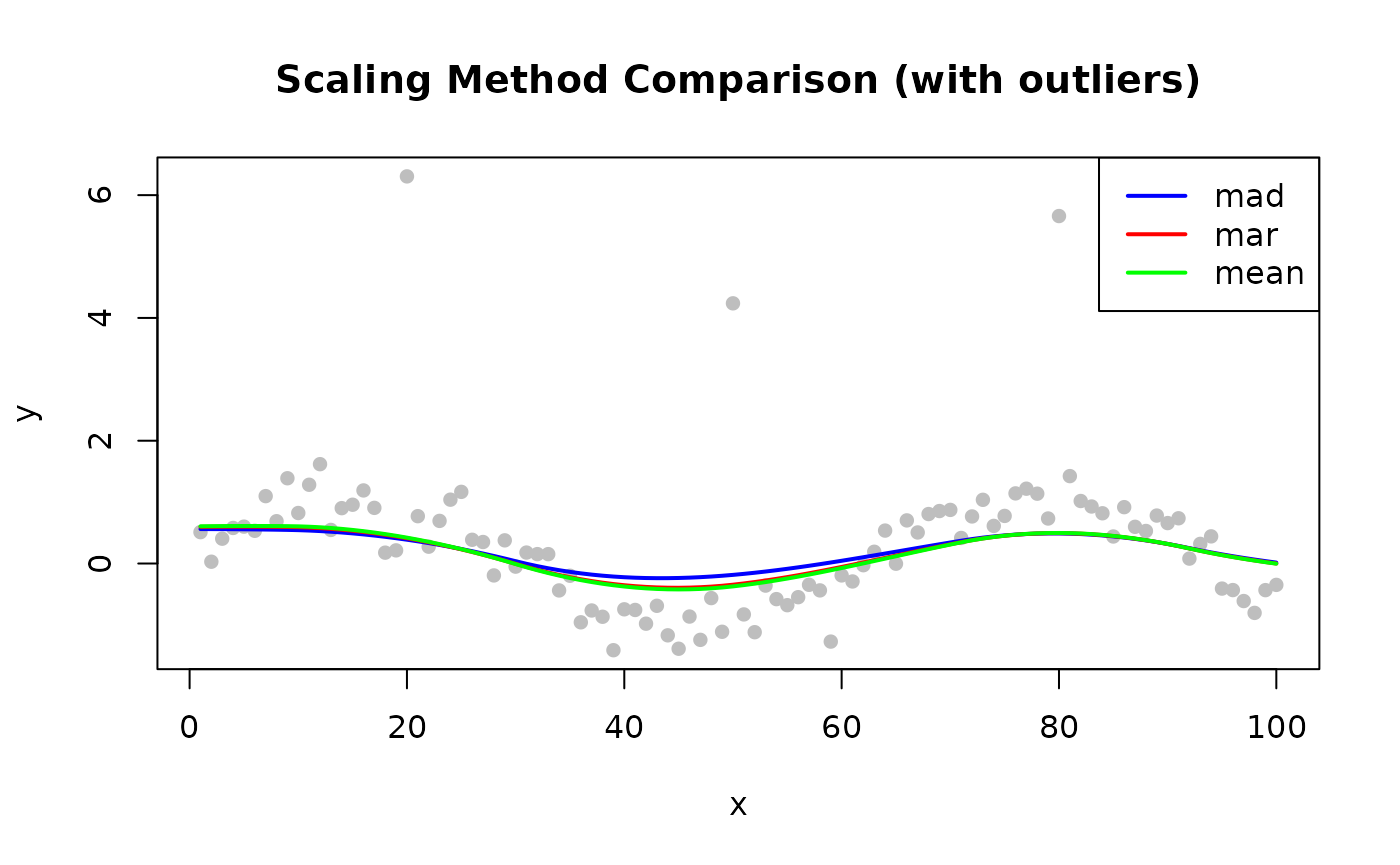
sessionInfo()
#> R version 4.6.1 (2026-06-24)
#> Platform: x86_64-pc-linux-gnu
#> Running under: Ubuntu 24.04.5 LTS
#>
#> Matrix products: default
#> BLAS:   /usr/lib/x86_64-linux-gnu/openblas-pthread/libblas.so.3
#> LAPACK: /usr/lib/x86_64-linux-gnu/openblas-pthread/libopenblasp-r0.3.26.so;  LAPACK version 3.12.0
#>
#> locale:
#>  [1] LC_CTYPE=C.UTF-8       LC_NUMERIC=C           LC_TIME=C.UTF-8
#>  [4] LC_COLLATE=C.UTF-8     LC_MONETARY=C.UTF-8    LC_MESSAGES=C.UTF-8
#>  [7] LC_PAPER=C.UTF-8       LC_NAME=C              LC_ADDRESS=C
#> [10] LC_TELEPHONE=C         LC_MEASUREMENT=C.UTF-8 LC_IDENTIFICATION=C
#>
#> time zone: UTC
#> tzcode source: system (glibc)
#>
#> attached base packages:
#> [1] stats     graphics  grDevices utils     datasets  methods   base
#>
#> other attached packages:
#> [1] rfastloess_3.0.0
#>
#> loaded via a namespace (and not attached):
#>  [1] digest_0.6.39     desc_1.4.3        R6_2.6.1          fastmap_1.2.0
#>  [5] xfun_0.62         cachem_1.1.0      knitr_1.52        htmltools_0.5.9
#>  [9] rmarkdown_2.32    lifecycle_1.0.5   cli_3.6.6         sass_0.4.10
#> [13] pkgdown_2.2.1     textshaping_1.0.5 jquerylib_0.1.4   systemfonts_1.3.2
#> [17] compiler_4.6.1    tools_4.6.1       ragg_1.5.2        bslib_0.12.0
#> [21] evaluate_1.0.5    yaml_2.3.12       otel_0.2.0        jsonlite_2.0.0
#> [25] rlang_1.3.0       fs_2.1.0          htmlwidgets_1.6.4