Overview
Standard LOESS operates on a single predictor x. Setting
dimensions > 1 extends the neighbourhood search and
local polynomial fit into an n-dimensional predictor
space, enabling surface smoothing over spatial grids,
time–altitude combinations, and similar multi-predictor datasets.
| Dimensions | Use Case |
x Input Shape |
|---|---|---|
1 |
Time series, 1D signal (default) | Numeric vector |
2 |
Spatial surface, 2-predictor model |
n × 2 matrix |
3+ |
High-dimensional regression |
n × d matrix |
Note: Neighbourhood search scales with the number of dimensions. For
d ≥ 3keepfractionsmall and consider the"interpolation"surface mode (the default) to reduce computation.
1D — Standard (Default)
Single predictor. No configuration required.
library(rfastloess)
set.seed(42)
x <- seq(0, 10, length.out = 200)
y <- sin(x) + rnorm(200, sd = 0.2)

model <- Loess(fraction = 0.3)
result <- fit(model, x, y)
cat("First 6 smoothed values (1D LOESS):\n")
#> First 6 smoothed values (1D LOESS):
print(head(result$y))
#> [1] 0.3808654 0.3912167 0.4028709 0.4154835 0.4286045 0.4422857
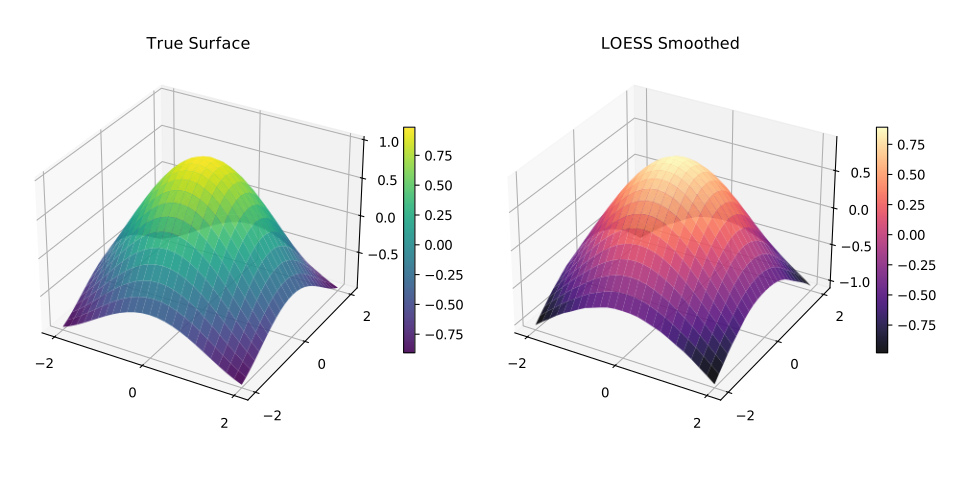
2D — Spatial Surface
Two predictors (e.g., latitude/longitude, time/altitude). Pass an
n × 2 matrix as x.
set.seed(42)
n <- 100
lat <- runif(n, -pi, pi)
lon <- runif(n, -pi, pi)
z   <- sin(lat) + cos(lon) + rnorm(n, sd = 0.1)

x2d <- cbind(lat, lon)   # n × 2 matrix

model <- Loess(fraction = 0.3, dimensions = 2L)
result <- fit(model, x2d, z)
cat("First 6 smoothed values (2D LOESS, lat/lon):\n")
#> First 6 smoothed values (2D LOESS, lat/lon):
print(head(result$y))
#> [1]  0.8862701  0.1927108 -0.9944883  1.2333466 -0.3672725 -0.8455709
3D and Higher
Pass an n × d matrix as x. Higher
dimensions require a larger fraction to keep the local
neighbourhood populated.
set.seed(42)
n <- 200
x1 <- runif(n)
x2 <- runif(n)
x3 <- runif(n)
y  <- x1 + sin(2 * pi * x2) + x3^2 + rnorm(n, sd = 0.1)

x3d <- cbind(x1, x2, x3)   # n × 3 matrix

model <- Loess(fraction = 0.5, dimensions = 3L)
result <- fit(model, x3d, y)
cat("First 6 smoothed values (3D LOESS):\n")
#> First 6 smoothed values (3D LOESS):
print(head(result$y))
#> [1] 0.1068976 1.2894880 0.3929455 1.2633451 1.9611165 0.6332138
Distance Metrics for Multivariate Data
When dimensions > 1 you can also control how
inter-point distances are computed.
| Metric | Description | When to Use |
|---|---|---|
"normalized" |
Scaled by dimension range (default) | Mixed-scale |
"euclidean" |
Raw Euclidean distance | Same-scale predictors |
"minkowski:p" |
Minkowski () norm | Custom geometry |
"weighted" |
Per-dimension via weighted_metric_weights
|
Anisotropic |
# Reuse the 2D spatial data from above; upweight the lat dimension
model <- Loess(
    fraction = 0.3,
    dimensions = 2L,
    distance_metric = "weighted",
    weighted_metric_weights = c(2.0, 1.0)  # lat counts twice
)
result <- fit(model, x2d, z)
cat("First 6 smoothed values (2D LOESS, weighted distance):\n")
#> First 6 smoothed values (2D LOESS, weighted distance):
print(head(result$y))
#> [1]  0.7660138  0.1220163 -1.0388792  1.1475979 -0.3815295 -0.9092784
Surface Mode for Multivariate Data
| Mode | Behaviour | Speed |
|---|---|---|
"interpolation" |
Grid-fit, interpolate elsewhere (default) | Fast |
"direct" |
Fit directly at every query point | Exact, slower |
# Exact fit at every point — slower but no interpolation artefacts
model <- Loess(fraction = 0.3, dimensions = 2L, surface_mode = "direct")
result <- fit(model, x2d, z)
cat("First 6 smoothed values (2D LOESS, direct surface):\n")
#> First 6 smoothed values (2D LOESS, direct surface):
print(head(result$y))
#> [1]  1.0042372  0.1831346 -0.9723946  1.0257415 -0.3229626 -0.9038626
For large 2D or 3D datasets use "interpolation"
(default) and tune cell and
interpolation_vertices to control grid resolution.
model <- Loess(
    fraction = 0.3,
    dimensions = 2L,
    surface_mode = "interpolation",
    cell = 0.2
)
result <- fit(model, x2d, z)
cat("First 6 smoothed values (2D LOESS, interpolation surface):\n")
#> First 6 smoothed values (2D LOESS, interpolation surface):
print(head(result$y))
#> [1]  0.8862701  0.1927108 -0.9944883  1.2333466 -0.3672725 -0.8455709
sessionInfo()
#> R version 4.6.1 (2026-06-24)
#> Platform: x86_64-pc-linux-gnu
#> Running under: Ubuntu 24.04.5 LTS
#>
#> Matrix products: default
#> BLAS:   /usr/lib/x86_64-linux-gnu/openblas-pthread/libblas.so.3
#> LAPACK: /usr/lib/x86_64-linux-gnu/openblas-pthread/libopenblasp-r0.3.26.so;  LAPACK version 3.12.0
#>
#> locale:
#>  [1] LC_CTYPE=C.UTF-8       LC_NUMERIC=C           LC_TIME=C.UTF-8
#>  [4] LC_COLLATE=C.UTF-8     LC_MONETARY=C.UTF-8    LC_MESSAGES=C.UTF-8
#>  [7] LC_PAPER=C.UTF-8       LC_NAME=C              LC_ADDRESS=C
#> [10] LC_TELEPHONE=C         LC_MEASUREMENT=C.UTF-8 LC_IDENTIFICATION=C
#>
#> time zone: UTC
#> tzcode source: system (glibc)
#>
#> attached base packages:
#> [1] stats     graphics  grDevices utils     datasets  methods   base
#>
#> other attached packages:
#> [1] rfastloess_3.0.0
#>
#> loaded via a namespace (and not attached):
#>  [1] digest_0.6.39     desc_1.4.3        R6_2.6.1          fastmap_1.2.0
#>  [5] xfun_0.62         cachem_1.1.0      knitr_1.52        htmltools_0.5.9
#>  [9] rmarkdown_2.32    lifecycle_1.0.5   cli_3.6.6         sass_0.4.10
#> [13] pkgdown_2.2.1     textshaping_1.0.5 jquerylib_0.1.4   systemfonts_1.3.2
#> [17] compiler_4.6.1    tools_4.6.1       ragg_1.5.2        bslib_0.12.0
#> [21] evaluate_1.0.5    yaml_2.3.12       otel_0.2.0        jsonlite_2.0.0
#> [25] rlang_1.3.0       fs_2.1.0          htmlwidgets_1.6.4